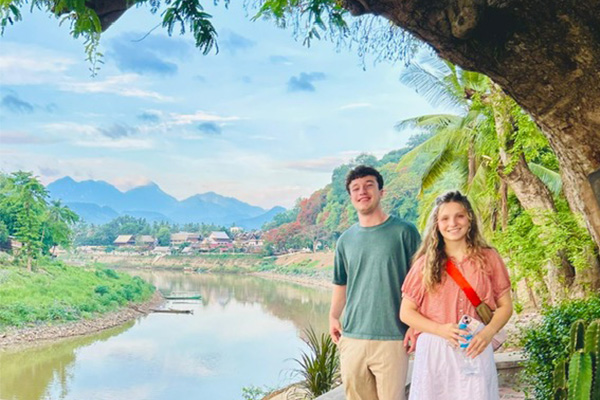
Lilly Lowe and Miles Redding are familiar with working in classrooms. As UD teacher education students, they complete 800 hours of hands-on experience before graduation. But during the summer, familiarity gave way to something new — living and teaching in Laos.
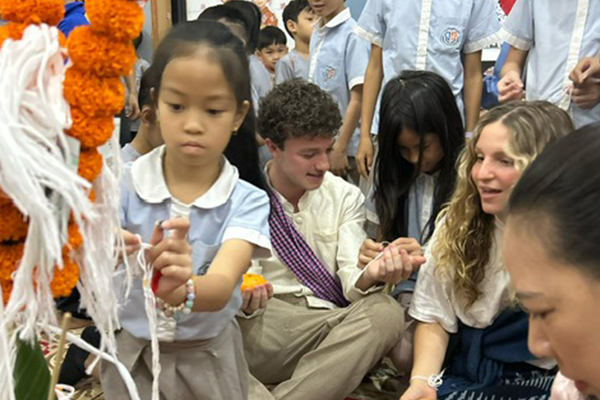
“We were chosen to go to Laos as part of a program through (UD's) Teacher Education Department and (UD’s) Human Rights Center,” said Redding, a junior adolescence and young adult education major. “We were partnered with the Diamond International School, an English-based school. We got to teach there, as well as be immersed in Lao culture in general, which was just an unreal experience for us.”
Quality hands-on experience
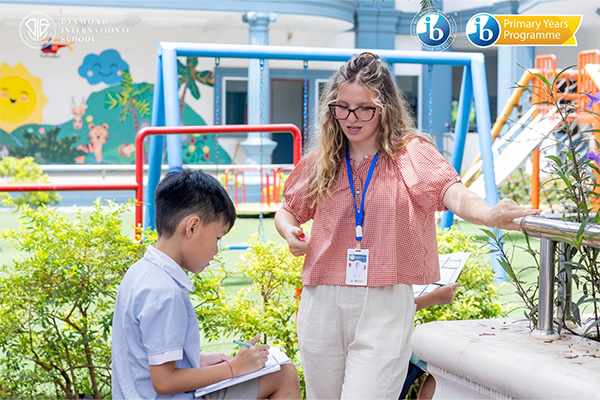
Before leaving for the trip, Redding spent time observing and assisting in Dayton-area schools. But his first experience teaching a unit of content, which is the step before teaching an entire semester, was with fourth grade Laotian students.
Redding said he initially wasn’t sure what to expect of the students and was pleasantly surprised to witness similar tastes in silly jokes and internet memes, key ingredients for building rapport.
“It was such a cool experience for me to realize that no matter where I go, whether it would be in the U.S. or abroad, whether in a rural school, urban school or suburban school — any kids are going to be kids, and you can learn to work with anybody,” he said.
While working on reading skills with a student who was struggling, Lowe, a senior studying early childhood education, was initially concerned about her skills translating appropriately. She didn’t know if her ability to tutor and teach young children to read in English by using the Latin script alphabet would translate well to an English language learner whose first language didn’t use the same building blocks.
She learned that wasn’t the case — her skills were helpful, it was her confidence that needed support.
“I was constantly learning not just about them and their culture, but how to be a better teacher when I came back to the states,” Lowe said. “They weren't just teaching me about themselves, they were teaching me how to flip content, how to think about things and how to teach English language learners.”
Teaching with a human rights focus
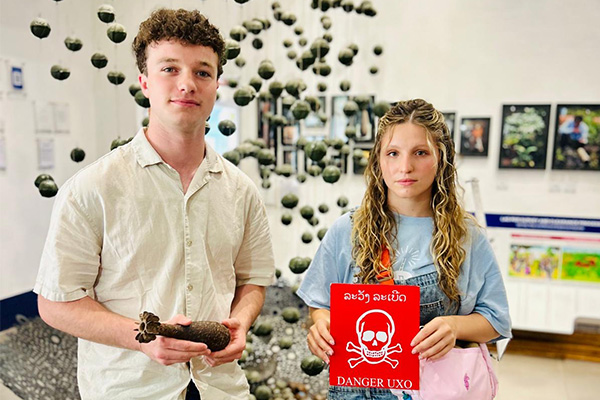
Rochonda Nenonene, a UD teacher education associate professor, said there were two main goals with this study abroad and teaching immersion. One goal was to learn about Laotian culture, customs and history, particularly regarding the Vietnam War’s impact and longstanding consequences of unexploded military ammunition, and to visit world heritage sites. The other was to practice culturally responsive teaching and develop culturally appropriate lessons alongside the international school faculty.
Redding and Lowe shared their shock at learning Laotians are dealing with the effects of a war nearly 50 years ago. They visited centers to learn about the unexploded military ammunition, and were confronted with the harsh reality of seeing the same information present in textbooks for their students.
Learning at the laundromat
A key moment of insight for Lowe and Redding happened outside of the classroom in Laos. Washing and drying laundry, a chore they regularly did at home, turned into their barometer of cultural exploration.
The language barrier, following metric measurements, using open-air laundromats in a humid environment and taking shoes off at the door were just a few of the little things that added up to one big learning curve.
“It became this silly little joke, but it turned out to be a great analogy for everything that happened there,” Lowe said. “It was finding your comfortability, and also finding out how you can face that challenge and how you are going to be flexible. In the end, the laundromat worked out, and so did everything else.”
Redding and Lowe stated they considered themselves to be open-minded and without prejudice before they left. Moving thousands of miles away to Laos helped them realize the subtle ways humans make sense of the world, and how disorienting it is to be flooded with differing information.
Ultimately, this insight and the experiences that took them out of their comfort zones helped them become more comfortable with confrontation and overcoming challenges.
“I didn't expect to grow as a person as much as I did as an educator,” Redding said, “but I think I 100% did.”