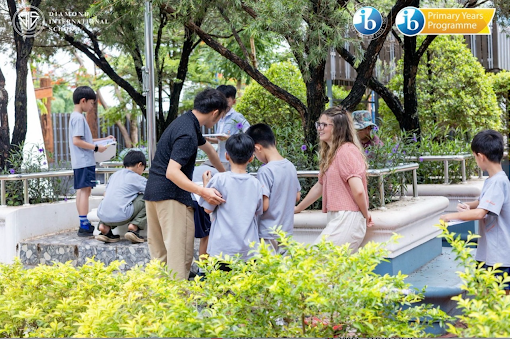
Welcome to Laos! Laos is home to a diverse culture and rich history, bordering countries including Thailand, Vietnam, and Cambodia. Prior to this experience, I was not sure what to expect when traveling to this country. Would it be similar to other Asian countries? What would the food be like? Would language create barriers I could not overcome? The wonders were endless. However, after a month in Laos, I can confidently say the wonders have not stopped. In fact, they have only grown. This experience allowed me to open my mind to a new place, to a history I had not yet encountered, and to a community that I cannot help but miss deeply.
Upon arrival in Laos, our trip liaison, Stephen White, head of academic affairs at Diamond International School, began building our knowledge of the impact of both the Vietnam War and the Secret War in Laos, the most heavily bombed country per capita during both of these tragic operations. It holds a history that challenges you to reflect on the impacts on the past, present, and future of not just the country, but the people who make it. In Laos, there are what are called Unexploded Ordnance, or UXOs, plaguing many parts of the country, including farmland, waterways, and other areas, creating safety hazards for people. These UXOs are active bombs left behind by cluster bombs used during the Vietnam and Secret Wars, which ended in 1975, so what does this mean for the country now?
When we think of war, we think of the devastation that occurred during it, but in Laos I learned that the effects did not simply disappear when the fighting ended. They exist in the land, the communities, economies, and other systems, including education. Learning about this history opened my eyes to the challenges education is facing in Laos today. While public school is often free, families still face indirect costs, and in some communities, students may need to leave school in order to help support their families. Stephen also gave us insight into the limited access to literacy resources, including books in several areas. These challenges can make it increasingly difficult for students to develop strong literacy skills. Additionally, many schools teach only English, which can contribute to concerns about preserving and expanding the use of the Lao language. While this history was insightful, the more time I spent in Laos, the more I realized that the country is not defined by its history but by the people who strive for peace and embrace one another each day with open arms.
At the Diamond International School, which is open to all Lao students, Stephen wants to integrate the science of reading not just into English instruction but also into Lao language instruction. During our time in Laos, Miles, another Summer Fellow, and I got to be a part of this exciting project. I was personally working with students, teaching them English, not just how to speak it, but also the rules, grammar, and the similarities and differences between languages. Experiencing the countless laughs, teachable moments, and all that the students taught me about their cultures in turn was extraordinary. While teaching, and more importantly, learning, Stephen and Teacher Sue, one of the many amazing teachers at this school, were actively encouraging us to have conversations about the overlap between languages and to think critically about what this could mean for the development of a literacy program. We found and explored concepts such as punctuation and tonal markers, and understood that they both convey meaning in writing, which led us to look into how we could actively demonstrate these concepts to students. Knowing only how to say hi and thank you in Laos, I did not realize how much I would be able to participate in these conversations. Nevertheless, the immense kindness and absolute embrace from the school and community enabled me to be part of conversations that truly inspired me and that I believe in tremendously.
While I believe it is incredibly important to highlight the challenges and impacts of war, I want to recognize the people and the beautiful collectivist culture of Laos. The ways Miles and I were embraced did not end at the school, but were carried through every interaction with the country. The first night that Miles and I were in Vientiane, we were invited to play ultimate frisbee with a group of Stephen's friends. There is only one word to describe ultimate frisbee on Monday nights in Laos: hot! On a more serious note, frisbee became something to look forward to each week, and we met so many amazing people. On the first frisbee night, we got back to our hotel and ventured out to find dinner. Just a few blocks from our hotel, we found a restaurant with outdoor seating. We ordered our food, sat outside, and within a few moments we were invited to join a group of young adults around our age for dinner. We spent the whole night talking, trying assorted foods, and just being absolutely immersed in this brand new culture. This experience encompassed what Laos is all about. You will never eat alone; if you lose something, it will be found and returned to you (there was a bit of a necklace incident), and you will leave with a Laos-shaped hole in your heart and the desire to never stay still again.
In Laos, I took each day step by step and learned to find peace in the calm. Laos taught me more than I could ever imagine, and I could not be more grateful for this experience. If you decide to embark on an adventure abroad, go in with an open mind, be ready to learn more than you could ever teach, and be present, because there is so much beauty in each moment that you choose to welcome the world around you.
Lilly Lowe is a rising senior at the University of Dayton, majoring in Early Childhood Education and Intervention Specialties.