First, a call. Next, a calling.
When Kelsey Fyfe ’11 first reached out to Joe Smucny ’92, she wasn’t looking for a job. She was looking for answers.
At the time, Fyfe was involved in Flyer Enterprises, serving on a small student team exploring ideas for a new nonprofit arm of the organization. One concept stood out: a consulting service for nonprofits — “a nonprofit for nonprofits,” as she remembered it.
To learn what consulting actually entailed, she turned to the University of Dayton alumni network and Flyer Consulting, the student‑run group that gives students client experience and helps them apply classroom knowledge through nonprofit and small‑business support.
“I was like, ‘Well, what’s this whole consulting thing about?’” she said. “Why don’t we reach out to UD alumni who happen to be in the consulting industry and pick their brains?”
That’s where Smucny entered the picture.
A mechanical engineering graduate, Smucny had built a long career in consulting, from large firms to small ones, from startup attempts to serving as a CIO. Eventually, he launched the Cleveland practice of Centric Consulting, where he still works today.
Fyfe found him through Flyer Connection — an online platform connecting students with alumni — and sent a message.
“I remember that moment very clearly,” Smucny said.
Their first conversation was over the phone, diving into business requirements and service offerings. Soon after, Smucny invited her to meet Centric Cleveland employees and other Flyers in Cleveland at two Willoughby bars with UD ties.
“It wasn’t that awkward meet and greet,” Fyfe e said. “Everybody was forthcoming, kind, genuine. I remember walking out thinking, ‘That was really exhilarating.’”
“He’s one of the most constructively direct people I know. You’re never second‑guessing where you stand or what you need to focus on. Leadership is making tough decisions and having difficult conversations but doing it with respect.”
Centric’s culture stood out. The company was founded as a remote organization long before remote work was common. Its CEO, Larry English, later wrote Office Optional, a book published one month pre-COVID, capturing the company’s early commitment to flexibility and trust.
“They were remote before remote was cool,” Fyfe said.
Smucny remembered being struck by Fyfe’s confidence.
“She had her you‑know‑what together,” he said. “I walked out of the bar and told the others, ‘I’m going to work for her someday.’”
He wasn’t joking. Today, Fyfe is one of Centric’s newer Cleveland partners, having joined the company in January 2020 after years in digital marketing agencies and an internship at the Cleveland Clinic. Her first week included meeting the entire company on its annual trip — that year in Nashville — just before the pandemic shut everything down.
“It was great timing,” she said. “I got to meet everybody in person, and then we went fully remote like the rest of the world.”
Centric’s preexisting culture made the transition seamless. The company even helped other organizations adapt, deploying remote work enablement programs and supporting both technology and people.
Culture, both noted, is the thread that ties Centric and UD together.
Smucny described it as “always feeling welcome on someone’s porch.” He observed it in the company’s quirky traditions — like its self‑managed PTO policy and its no‑work holiday trips, where talking shop is jokingly grounds for “being fired.”
He also saw it in Fyfe.
“Kelsey is very genuine,” he said. “She’s never faking it. She’s super honest and straightforward. She makes hard things look easy.”
Fyfe says Smucny modeled leadership from the start.
“He’s one of the most constructively direct people I know,” she said. “You’re never second‑guessing where you stand or what you need to focus on. Leadership is making tough decisions and having difficult conversations but doing it with respect.”
She also credits him with showing her what leadership looks like outside the office: being active in the community, building connections and helping others succeed.
“Good leaders emulate what it means to be a good leader,” she said. “Joe is the first person to bridge an introduction or give you honest feedback.”
Their relationship, both say, is rooted in trust — something they think of as distinctly Marianist.
Fyfe points to UD’s core values: “A diverse, collaborative, inclusive environment founded on teamwork, trust and mutual respect.” She laughed when she reread them recently. “Did we copy and paste that?” she joked.
“I’ve never interviewed a UD student that I didn’t want to hire.”
Smucny sees the same overlap.
“I’ve never interviewed a UD student that I didn’t want to hire,” he said. “It’s about who you’d spend four hours in a car with. If you can’t do that, you probably shouldn’t be working with them.”
Both offer similar advice to students and alumni hoping to build connections.
“Never say no to meeting new people, or taking up an opportunity to help someone,” Smucny said. “Everybody needs help. Try to have 15 coaches or mentors — different ages, genders, career styles. Their diversity helps you learn from different angles.”
Fyfe encourages students to start with alumni who have already opted in to helping, such as those listed through the Career Center. But she also emphasizes preparation.
“These folks are graciously giving you their time,” she said. “Be specific. Do your research. Have pointed questions. Show you care. Thoroughly listen with intent.”
And when it comes to their relationship, both say it’s not going anywhere — even as Smucny looks optimistically toward retirement. He knows Centric is in capable hands.
“I’m never going to not have the Centric logo on my forehead,” he said. “We want to be around for 100 years.”
“You’re not getting away from me, Joe,” Fyfe joked. “Even if it’s 20 years from now, I’ll still call.”
And if their story is any indication, the Flyer network — and the relationships it sparks — will be, too.
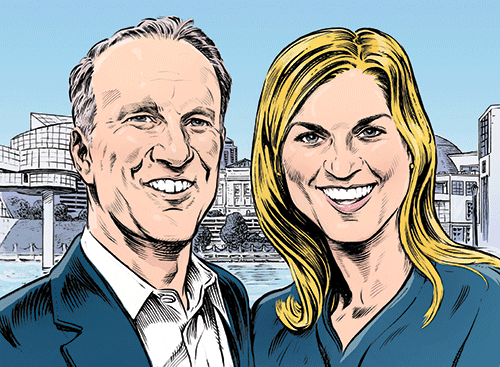
Illustration by Lars Leetaru.
A version of this article appears in print in the Autumn 2026 University of Dayton Magazine, Page 1. EXPLORE THE ISSUE — MORE ONLINE