Most nervous flyers have similar fears boarding a plane. What if there’s turbulence? What if it crashes? What if I get to my window seat that I paid for and someone’s already sitting there?
Most passengers wouldn’t even consider a different danger lurking below: fungus and black mold and bacteria, oh my!
Luckily for commercial airline passengers, the risk of such contamination is low because of how often these aircraft are flown. However, that’s not the case for military planes and helicopters, many of which are stored in warmer and wetter regions of the world in perfect environments for fungi to bloom.
And that moldy bad stuff? It’s the kind that can colonize and degrade the coatings of planes.
That’s why a University of Dayton student, two UD professors and scientists from the Air Force Research Lab at Wright Patterson Air Force Base and Naval Research Laboratory in Washington, D.C., teamed up to figure out how fungi are eating through the polymer coatings in planes.
The Problem
Justin Biffinger, associate professor of chemistry at UD, has spent the better part of a decade researching exactly this. He has been working alongside scientists at the Air Force and Naval Research Laboratories and a fellow UD chemistry professor Matt Lopper to trace the origins of this slow-moving biological threat.
“The Air Force basically fished out the organisms that were doing that degradation,” Biffinger said. “We’ve been working with them for the last eight years deciding on the foundational mechanism of the first colonizers.”
Those first colonizers, mostly fungus and yeasts, are the key. Every panel covered by black mold means a plane needs to be pulled from storage and treated with harsh cleaning agents before it’s airworthy again. The research team wanted to understand exactly how that process starts.
The research focuses on some of the earliest colonizers that perform the initial degradation. This first breach ultimately leads to the succession of other microorganisms and molds that then live off that first degradation. The challenge lies in identifying the exact chemical trigger that turns a harmless surface into a biological buffet.
The Research
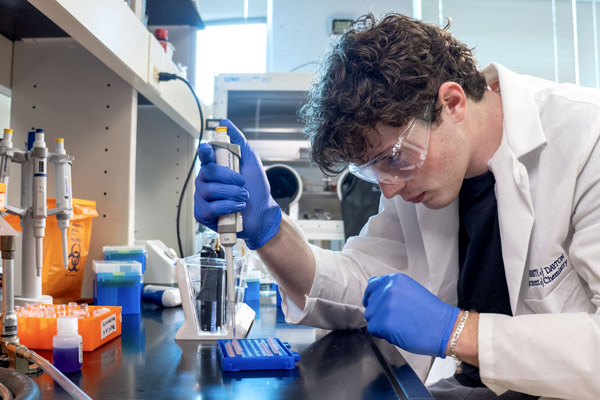
Enter Peter DeSocio ’27, a pre-med junior who joined the project at the start of his sophomore year at UD. His task: identify the specific enzymes involved in that initial degradation, express them in another host, and evaluate how active they are. DeSocio has been working with two strains of yeast, Papiliotrema laurentii and Naganishia albida, and identified a hydrolase enzyme that had never been documented in those organisms.
“I’ve come to love research,” DeSocio said. “I want to continue that even in the healthcare work I eventually do.”
The goal is ultimately to find a common mechanism that explains why these organisms are so successful at breaking down coatings inside and outside of aircraft. Biffinger sees the research pointing in two promising directions: developing resistant coatings from the start or identifying enzymes active enough to strip and recycle existing ones.
“If we find a particularly active enzyme, you could license that as an enzymatic treatment for stripping planes, cars or deteriorating plastics so they can be reused,” he said. “That means breaking down a polymer into monomers you can reuse.”
Why It Matters
Right now, no coating nor treated surface can stop the colonization of microorganisms (and ultimately the biodegradation of the supporting material) over a long enough period. Understanding the biochemistry behind the degradation opens the door to something better and more sustainable.
That sustainability angle extends beyond the military. Plastics degradation is one of the more stubborn environmental problems of our time, and the enzymes this team is identifying could have applications well outside of U.S. Department of War hangars.
Donor-funded
The whole project was originally funded by SERDP (Strategic Environmental Research and Development Program) and DeSocio’s summer research was made possible through UD’s Dean’s Summer Fellowship, funded in part by One Day, One Dayton donors. Because the fellowship provided a stipend, DeSocio didn't have to seek outside employment — allowing him to treat his research as a full-time summer job.
But Peter nearly missed the opportunity entirely.
“I wasn’t even aware it was a thing until my advisor mentioned it during the last week you could apply,” DeSocio said.
The fellowship gave him time to make real progress, time that’s hard to carve out during the school year.
“We applied together with Dr. Biffinger as my mentor,” DeSocio said. “It worked great; we had the time to get the different parts of the manuscript done.”
With the paper now in progress, DeSocio and Biffinger are heading into a second summer together, wrapping up the final experiments while also exploring a new avenue: cell-free protein expression.
The Future
The research has implications that stretch well beyond the hangar. Biffinger frames it simply: “Humans have engineered plastics for nearly every imaginable use, leaving nature with little evolutionary incentive to break them down. That’s why studying how natural processes can lead to polymer coatings and plastics degradation offers a sustainable, renewable strategy for addressing these persistent materials and the microorganisms associated with them in a new way.”
The current polymer degradation efforts now include how volatile organic compounds impact the polymer degradation of protective polymer surfaces through an Air Force Research Laboratory led program funded through the Office of Naval Research.
DeSocio, who is planning a gap year before medical school and hopes to continue research wherever he lands, sees it the same way.
“Research takes funding and donations, and this shows where those funds are going,” he said. “It’s helping humans and the environment by finding ways to degrade plastic.”
Distribution A. Approved for public release: distribution unlimited. AFRL-2026-3402