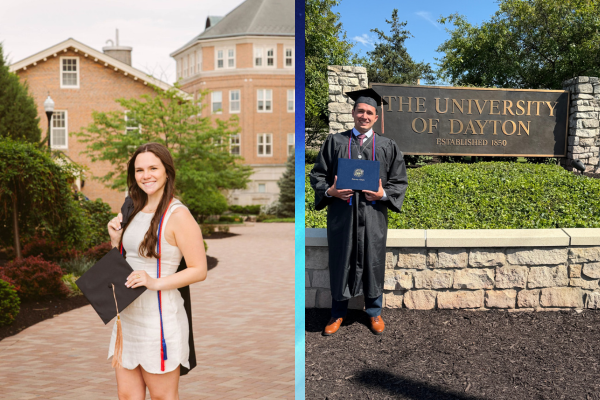
For University of Dayton business seniors Charlotte Harper ’26 and Charles Mathot ’26, graduation was approaching with one major question still unanswered: What comes next?
Both were preparing to enter the workforce without a full-time position secured. Harper, a marketing major with a psychology minor, navigated the uncertainty of the job search, while Mathot, who studied management information systems and operations and supply chain management, looked for ways to stand out in a competitive market.
They found additional support through The Edge Program, a donor-funded initiative created by the University of Dayton School of Business Administration to help members of the Class of 2026 navigate the transition from college to career in a challenging market.
Meeting Students Where They Are
Designed specifically for seniors who had not experienced the School of Business Administration’s Career Flight Plan curriculum, The Edge Program provided targeted career preparation at a pivotal point in their Dayton experience.
In Fall 2025, fifty business students who planned to graduate in Spring 2026 participated in the semester-long program, working with 10 mentors who offered personalized guidance and encouragement. Students also learned from guest speakers and participated in practical experiences, including a professional etiquette meal designed to prepare them for interviews and workplace settings.
“For most students, they were anxious because they had not secured a full-time position after graduating,” said Misty Bruns, lecturer and director of The Edge Program. “In some cases, this impacted their confidence because they thought they had done all of the right things during college.”
Rather than starting over, The Edge Program helped students recognize and better communicate the value they already brought to employers.
“Working directly with mentors helped them see that the right job was there, and their confidence grew each step of the way,” Bruns said.
For Harper, that meant changing how she approached networking.
“Before joining The Edge Program, I thought of networking as something you did when you needed a job,” she said. “This program helped me see it more as building genuine connections with people and learning from their experiences.”
Practicing elevator pitches helped Harper become more comfortable articulating her experiences, while conversations with alumni, employers and other professionals provided perspective.
“Hearing about the successes, challenges and unexpected turns in other people's careers made the transition after college feel much less overwhelming,” Harper said.
Confidence, Connections and Persistence
Mathot entered The Edge Program after struggling to secure a position. His job search would ultimately include more than 200 applications, making the support of his mentor especially valuable.
“It hurts getting rejected, but if you make every rejection a personal attack against yourself, you won't make it through,” Mathot said. “So keep pushing forward.”
That personal support was at the heart of The Edge Program. Mentors met regularly with students, reinforcing what they were learning while serving as sounding boards throughout the job search.
Harper experienced that support firsthand with Bruns as her mentor.
“Misty was my personal mentor, and she guided me in many different ways and made me feel like I could ask her for help with anything,” Harper said. “It felt like they were truly helping us prepare for life rather than just completing a program.”
Mathot left The Edge Program with a similar shift in perspective.
“I left with a confidence that I can get a job and I have all the tools and support to do so,” he said. “All I needed was a chance to prove it.”
Today, Harper is beginning her career as a logistics account executive trainee at Total Quality Logistics (TQL), while Mathot’s persistence also paid off with a full-time opportunity as a supply chain specialist working in purchasing at Microchip Technology.
An Investment in Student Success
Donor support made The Edge Program possible, allowing the School of Business Administration to respond to an immediate need and provide 50 seniors with additional career preparation and mentorship before graduation.
“Our donors and alumni who support School of Business Administration programs are the heart and soul of what the University of Dayton represents,” Bruns said. “They create ways for us to support students and elevate our program, creating a legacy of excellence.”
For Bruns, the impact extended beyond securing a first job.
“Not only did many secure full-time opportunities, they all gained valuable experience, durable skills and confidence with the value they bring to the table,” she said.
That same commitment to professional preparation now begins earlier through the donor-supported Career Flight Plan, the School of Business Administration’s progressive, five-course career development curriculum, which provides structured career development throughout a business student’s undergraduate experience. The Edge Program helped ensure members of the Class of 2026 received additional support as they prepared to transition from college to career.
For Harper, knowing donors chose to invest in that support made the experience even more meaningful.
“It means a lot to know that alumni and donors are willing to invest in students and give them the opportunities that can genuinely impact their futures,” she said. “Their support gives students access to experiences, connections and mentorship that they may not otherwise have.”
Her message to the donors investing in students’ career preparation is simple :
“Thank you for investing in students and believing in our potential. Your generosity goes far beyond funding a program; it allows students to learn from professionals, build relationships and feel more confident as they enter the workforce.”