Finding his runway
John D. Porcari ’81 prefers flying over all other modes of transportation. A Flyer through and through, he’s spent his life building the kind of infrastructure that helps everyone else get off the ground. But long before he was catching flights, Porcari was catching public meetings in church basements as the son of a Rochester, New York, city official.
Those early nights in church basements stayed with him. So when he boarded a Greyhound to Dayton to visit his older brother, Jim Porcari ’79, he was already tuned to the rhythms of public life.
What began as a weekend visit to UD became a turning point. Soon Porcari was back on campus, sitting in history professor Pat Palermo’s American History Since 1865 course, where his interest in public service and infrastructure flourished. Assigned only a chapter of The Power Broker: Robert Moses and the Fall of New York by Robert Caro, the political science major read the full book. The story of a master builder who lost his way captured his imagination.
“There’s more than one way to serve. It’s only limited by your imagination.”
“There was a lot of other reading I probably should have been doing, but I plowed through that book,” Porcari said.
That appetite for understanding grew. Sampling history, philosophy, international relations and even an engineering course, Porcari’s mix of classes led him to one conclusion.
“There’s more than one way to serve,” Porcari said. “It’s only limited by your imagination.”
Before starting a career in economic development, Porcari biked through Europe with friends, worked as a construction laborer, moved to San Francisco and was a door-to-door canvasser for the California Public Interest Research Group. He eventually pursued graduate studies in public administration at the University at Albany.
In 1995, Porcari began work for the state of Maryland focused on economic development, environmental issues and neighborhood revitalization. But soon, a new path emerged.
“The more time I spent on economic development issues, the more I realized that transportation was a really big part of it,” Porcari said.
What followed was what he called a “transition by fire,” moving from one demanding job to the next. Staying calm, he said, was essential.
“If you’re operating a statewide highway system, transit system, ports and airports, there’s always something going wrong and there are always operational issues,” Porcari said. “You’re either connecting people to opportunities, or not. If you screw up, you’re not.”
What keeps Porcari grounded is the team around him.
“You realize quickly that you can’t do it yourself, and you shouldn’t,” Porcari said. “The people part of it is the one irreplaceable element. That’s as lasting — and important — as any physical infrastructure.”
Across four governors and two presidents, Porcari has accumulated wins for the communities he serves. Unwilling to point to just one highlight, he views his work through a critical, broader lens.
“Transportation is a means to an end, it’s not an end in itself,” Porcari said. “It’s community development, it’s economic development and opportunities for everyone in the community, it’s building and restoring a better physical environment.”
In 2009, during his second stint as Secretary at the Maryland Department of Transportation, Porcari received a life-changing phone call — from President Barack Obama’s transition team. For four-and-a-half years, he served as the deputy secretary and chief operating officer of the U.S. Department of Transportation, managing a $70 billion budget and 55,000 employees during the recovery from the Great Recession.
“When you’re asked to do something for your country, you just do it,” Porcari said. “It’s the honor of a lifetime.”
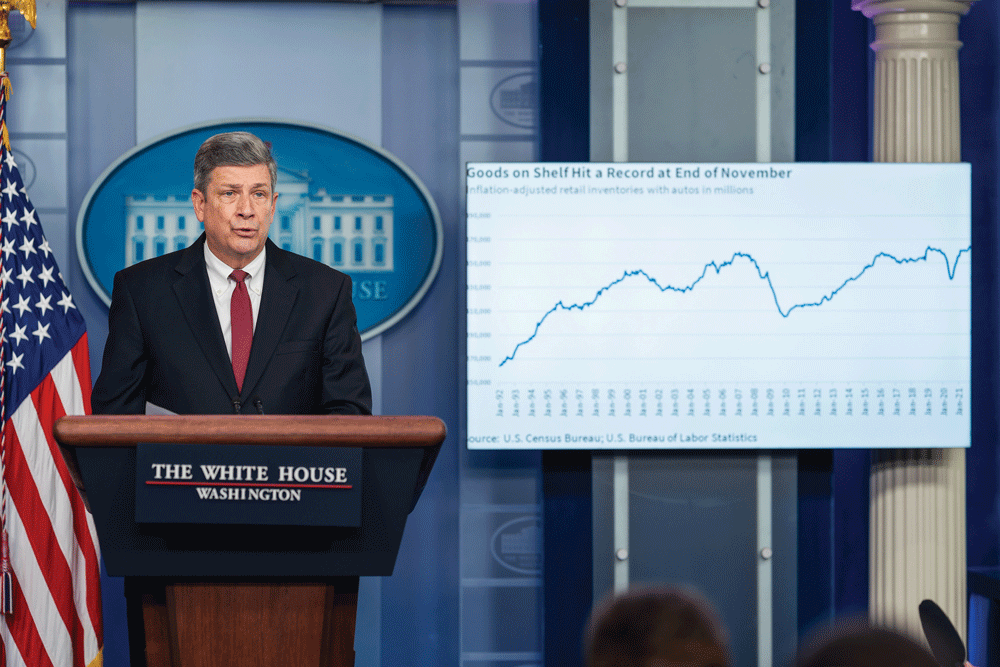
This wouldn’t be Porcari’s last time working with the White House. In 2021, President Joe Biden’s Domestic Policy Council requested his expertise to resolve the pandemic-induced supply chain crisis. What began as a 90-day volunteer role became 11 months of daily Zoom calls with up to 400 participants — from CEOs of major companies to dockworkers — in an all-out effort to combat an economic curveball.
Throughout the twists and turns of his career, Porcari credits his wife, Heidi Uhlenhake Porcari ’82, whom he met at UD, and their five children for the sacrifices they’ve made. Lifelong friends from UD have also been a constant in their lives, from being in their wedding party to serving as their children’s godparents.
“This country has given us so much. To give something back is nothing compared to what’s been given to us. The reason that we’re able to enjoy the life that we have today is because our parents, grandparents and great-grandparents worked so hard to build a better life, and we owe it to the next generation to do the same.”
With deep gratitude for the life he’s lived, Porcari said he’s always felt like he’s been “standing on the shoulders of giants.” It was a shared sentiment with Obama.
“On both sides of our family, from immigrants to first-generation college-bound, this country has given us so much,” Porcari said. “To give something back is nothing compared to what’s been given to us. The reason that we’re able to enjoy the life that we have today is because our parents, grandparents and great-grandparents worked so hard to build a better life, and we owe it to the next generation to do the same.”
Porcari continues to give back to UD through his involvement with the Dayton2DC student career immersion and support of the Human Rights Center. He said the center’s work, and the student projects emerging from it, are needed now more than ever.
“If you look at some of the discussions and some of the debates that are happening nationally right now, it’s really clear that if you thought about the world from a basic human rights point of view, we would be acting differently than we are today.”
Reflecting on a career of service and contributing to the common good, Porcari said his adopted philosophy of finding opportunities to give back “is kind of in the water at UD.”
“It reminds me of that old biblical phrase,” he said, “‘To whom much has been given, much will be expected’ — and we have been given a lot.”
“It reminds me of that old biblical phrase, ‘To whom much has been given, much will be expected’ — and we have been given a lot.”
A version of this article appears in print in the Autumn 2026 University of Dayton Magazine, Page 44. EXPLORE THE ISSUE — MORE ONLINE