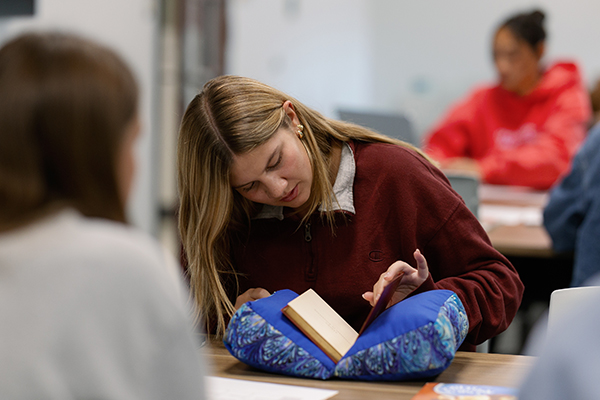
On Tuesday, Oct. 6, Flyers studying foundations of literacy with Mary-Kate Sableski, professor of literacy and special needs, pored over contemporary and historical children’s literature in Roesch Library.
Rather than viewing rare, centuries-old books from behind a sheet of glass, the students in the Kathleen M. Webb Special Collections Classroom held primary sources as they evaluated changes in themes and diversity over the years.
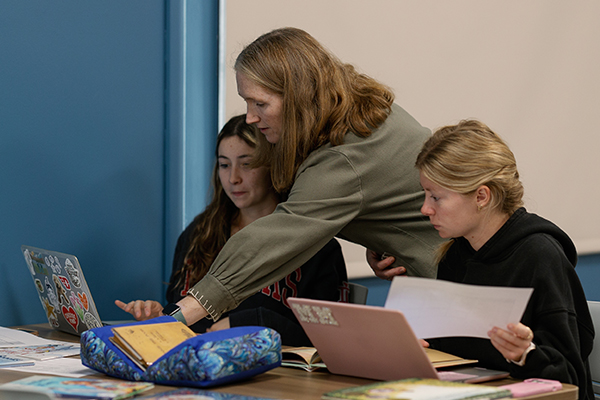
That same day, the University of Dayton held the classroom’s dedication ceremony in honor of Webb, University Libraries dean emerita, for 30 years of service and in recognition of Stuart and Mimi Rose, longtime supporters of the University and of rare books and special collections.
“This room will be a place of encounter where students literally touch history and see themselves within the continuum of human experience,” Dean Matt Shaw said at the ceremony.
The space gives students direct access to rare books, manuscripts, archival collections and artwork from the Marian Library, the U.S. Catholic Special Collection and University Archives.
“Because [the items] are one-of-a-kind, our team of librarians and archivists are entrusted to care for these materials so they can be used for many years to come,” said Kayla Harris, professor and associate dean for special collections. “This classroom … allows us to manage that preservation, while providing hands-on access to these artifacts in a welcoming and inviting environment.”
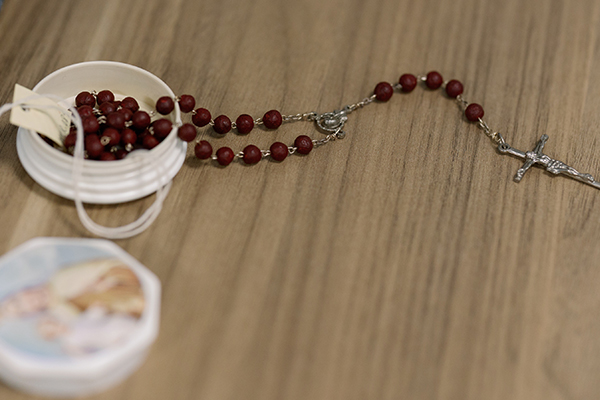
Harris is familiar with the process and awe that comes over students who get to work with, touch and hold items from these special collections. She shared that her favorite teaching item is a rosary made of dried and crushed rose petals.
When she asks students to pass it around, smell it and consider what the scent evokes in themselves, the answers vary between sentimental and humorous, but always strike a chord.
“Just like writing notes by hand can help learners recall information better, engaging our senses makes learning more concrete — it makes it stick,” Harris said.
Brookelyn Rice, a junior communication major, experienced that last fall when she visited the special collections space while taking a history of Christianity class, which examined photographs, postcards, brochures and other items from Lourdes, France, a popular site of Christian pilgrimage.
“At face value I saw a photograph and a postcard, but then I considered the deeper meaning. They were not just artifacts or religious objects, but tools for communication designed to tell the story of Lourdes beyond the pilgrimage site itself,” Rice wrote in a blog post.
Rice’s experience fueled her her research, “Lourdes in the Modern Age: Faith, Science, Mass Media,” which earned her the 2025 Fr. Jack McGrath, S.M., Award for Research in Catholic Intellectual Traditions.
“[This is] an important aspect of learning from special collection objects — they spark curiosity, inspire you to ask questions, but also force you to acknowledge that there isn’t always an answer,” Harris said. “Students have to make their own meaning using context, their best judgement and critical thinking.”
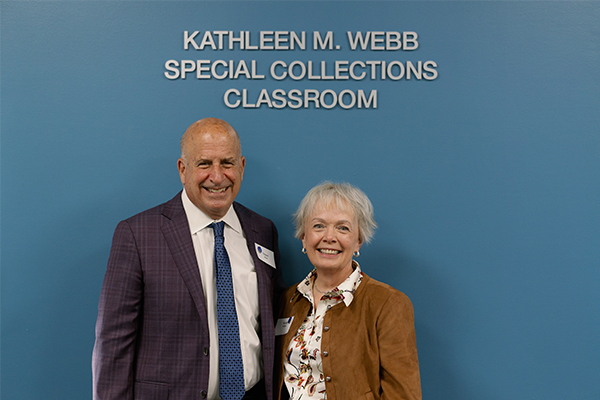
Webb, too, reflected on watching student and faculty faces light up when working with special and unique items.
In her tenure, she strived to better connect materials already in the libraries’ possession to faculty and their classrooms. Before any new acquisition, Webb recalls her first question being if it could be used in the classroom and for research.
But she also shared that it was challenging to accommodate classes when Roesch Library only had one classroom, and one that wasn’t suited for special collection items.
“Now, because of [Stuart and Mimi’s] generosity,” Webb said, “UD’s talented and committed librarians will have a space worthy of their innovative teaching techniques and especially the unique collections of the University.”