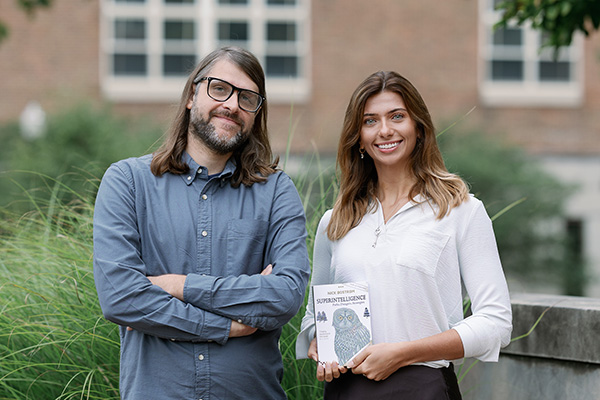
AI didn’t write this blog. And that’s exactly how senior Emma Basinski prefers it.
While chatting with the political science major, her passion for research alongside her moral conviction emanates from each word. You can easily picture her in the courtroom as a lawyer (a path she’s considered) or on Capitol Hill, lobbying for the rights of others.
But for now, she’s taken on a somewhat controversial opponent: artificial intelligence.
For anyone paying half attention to anything, you can’t miss the discourse on AI. Your algorithm is full of it; it’s the buzziest story out there. From doomsday scenarios to utopias to psychosis, AI has pundits and YouTubers alike sharing their hot takes about where the technology will lead us.
But it seems like the development of the tech (alongside the ongoing chatter about it) is moving far more quickly than the ethics of it. For Basinski, that’s a big problem.
The Questions
Who controls AI? Who decides what values get encoded into it? Who has the authority to regulate companies who create AI?
These are the questions that drove Basinski’s research this summer, made possible by the University of Dayton’s Dean’s Summer Fellowship. For her, these weren’t abstract questions. They came from what she was seeing happen around her every day in class.
“I really was seeing a shift from not using AI in classrooms — which I’m pro — to professors almost switching into ‘AI is a tool,’” Basinski said. “And I was like, in an academic setting, I don’t think we should be promoting that, because most students aren’t going to use it as a tool. They’re going to use it to get the job done.”
From AI governance to public accessibility, Basinski had plenty to dive into. But she needed guidance and a framework to answer her questions. Enter Trip Glazer, associate professor and chair of the philosophy department, whose name kept coming up among her friends
The Philosophy of AI
Glazer and Basinski approached the research as good philosophers do. They started with a book.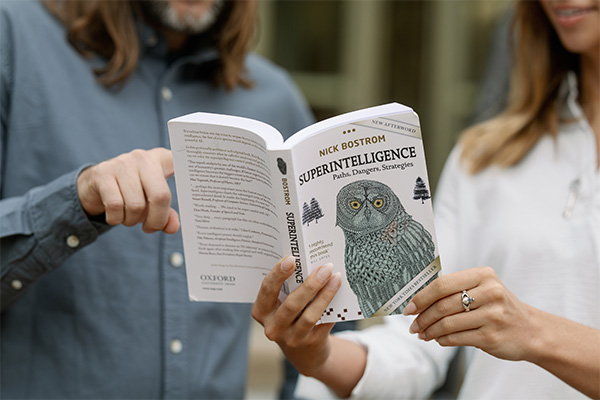
They explained that philosophy research can look different than the typical scientific method research employed by chemists or biologists. For their purposes, they started with Nick Bostrom’s Superintelligence: Paths, Dangers, Strategies.
“The main book we read [Superintelligence] was kind of predicting the future of AI,” Glazer said. “I think [Basinski] probably found that it was kind of eerie how accurate [Bostrom’s] predictions were about the sorts of problems we would run into.”
In his book, published in 2014, Bostrom looks at the risks of superintelligence, how quickly it could evolve, if it could be controlled and how its motivations, once it surpasses human capabilities, may not have humanity’s best interests at heart (or at its code). In 2003, Bostrom famously proposed the “Paperclip Maximizer” thought experiment, in which he posited how a superintelligent AI could destroy humanity in pursuit of a simple, but narrow goal (like producing as many paperclips as possible on Earth at any cost).
Basinski described her research with Glazer as taking a sort of Tuesdays with Morrie approach to the reading and discussion, meeting in-person weekly or bi-weekly to exchange and developing a roadmap for her paper.
Because the Dean’s Summer Fellowship provided Basinski a stipend, the Cleveland native was able to stay in Dayton for the summer, conducting her research by day while working at a restaurant at night. It also provided her flexibility to work on her project at a pace that suited the material.
Their reading and discussions were slow by design. The subject and source were not light.
“You kind of have to take it in chunks,” Basinski said, “Because it is so dense. You have to process it, maybe read things over twice, just so you’re fully understanding it. I think having the Dean’s Summer Fellowship allowing that 10 or 12 weeks that we were given helped so much. There was a midsummer report that all the dean's fellowship students did, so I think also seeing how far we’ve come from that point to now with the research is crazy.”
Democracy as a Check on AI
Basinski’s upcoming 20-page paper revolves around a simple claim: we should all have a seat at the table when it comes to AI governance.
“The public should have a role in determining how these systems are governed, through more transparency, more accountability for users and the companies, more public participation and democratic oversight as a whole,” she said. “I feel like these [AI] companies are not transparent at all.”
They discussed her framework using an analogy with environmental regulation. If a corporation wants to build a new factory near a neighborhood, there are rules and agencies in place to protect and inform the public. Basinski and Glazer argue, AI companies should go through similar risk assessments when they want to release a new model, and let those inform deliberations about how to regulate it.
The risks Basinski identifies already are unfolding. In healthcare, she points to AI systems that can embed existing disparities across gender and race lines. In hiring, she warns algorithmic screening tools carry ingrained biases that disadvantaged applicants may never even know influenced a decision.
“The concerns aren’t only for the future,’ Basinski said. “It’s already appearing so much in people’s everyday decisions. When these increasingly capable AI systems behave in ways that their developers didn’t even intend or fully anticipate, it makes the questions about oversight and accountability — who controls these systems — more immediate now more than ever.”
The Takeaway and the Future of the Research
If there’s one thing Basinski wants you to take away from her research it’s this: AI shouldn’t be deciding what we value and neither should the engineers and executives who create and sell it.
“Those decisions need to remain a part of our democratic society,” Basinski said.
She emphasized education is where the governance of AI starts.
“Before asking people what they think, I want everyone to know what AI actually is,” she said.
Glazer, for his part, couldn’t agree more.
“It was the easiest advising I’ve ever done,” he said of his time working with Basinski.
Basinski plans to submit the paper to undergraduate and academic journals in the coming months. For now, she’s focused on her senior year, and perhaps on a city she has her eye on for after graduation.
“I would love to be in D.C.,” she said. “Any opportunity I could get, especially connecting policy and ethics and the decisions being made in legislation, I would be so happy doing that.”