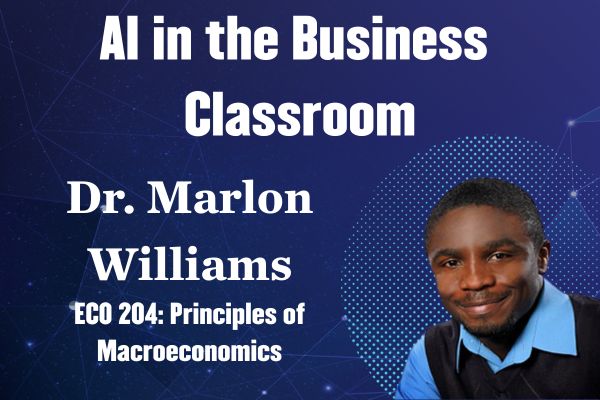
Artificial intelligence is changing how students access information. For Marlon Williams, associate professor of economics, that isn't a challenge. It's an opportunity to help students think more deeply.
In ECO 204: Principles of Macroeconomics, Williams uses AI to reinforce learning rather than replace it, reflecting the University of Dayton School of Business Administration's approach to integrating AI as a tool that strengthens the human side of education.
Meeting Students Where They Are
"Information is ubiquitous," Williams says. "Students can access answers instantly. So the goal isn't just delivering information—it's helping them understand it, evaluate it critically, and use it wisely."
That philosophy led Williams to create a customized AI tutor built around his lectures, course materials and teaching style. Rather than discouraging AI use, he teaches students how to use it intentionally.
AI as a Learning Partner
Instead of providing immediate solutions, Williams' AI tutor mirrors his Socratic teaching style by asking follow-up questions, encouraging reflection and guiding students through economic concepts.
"We don't want AI doing all the thinking," Williams says. "Learning happens when students engage with the material and when they wrestle with it a bit."
The tool is especially valuable in a first-year macroeconomics course, where many students are encountering economic concepts for the first time. It gives them a low-pressure environment to ask questions, make mistakes and build confidence.
Personalized Support Beyond the Classroom
Available around the clock, the AI tutor extends learning beyond office hours and offers students individualized support whenever they need it.
"AI gets us closer to that ideal of individualized support," Williams notes. "It's not replacing professors. It's complementing us."
Students have embraced the resource. Course surveys found that more than half used the AI tutor weekly, nearly one in five used it every time they studied and about 74% said it improved their performance.
Teaching Critical Thinking in an AI Era
Williams believes AI makes critical thinking more valuable, not less.
"Computers are better at memorizing than we are," he says. "Our value is in thinking critically, creatively, and asking better questions."
His AI tutor challenges students to analyze and apply concepts rather than simply accept answers. Because AI isn't perfect, students also learn to question results, verify information and use the technology responsibly.
Preparing Students for the Future
For Williams, AI isn't just improving one course. It's preparing students for careers where AI will be part of everyday work.
"AI is going to be part of their careers," he says. "Learning how to use it effectively now gives them an advantage later."
As students use AI to brainstorm ideas and strengthen analysis, they also learn the importance of pairing technology with sound judgment, curiosity and ethical decision-making.
More Than Economics
Williams sees economics as more than charts and formulas. It provides a framework for understanding everyday decisions and the trade-offs people make.
"If students can grasp that we have limited resources and unlimited wants, they start to see the world differently," he says. "That understanding helps them think more critically—not just as professionals, but as people."
Advice for Future Students
Williams offers one piece of advice to students entering his classroom: Be present.
"The students who thrive are the ones who give their full attention to the work in front of them," he says. "That's where real learning happens."
By combining intentional teaching with AI, Williams is helping students develop skills that extend far beyond macroeconomics—curiosity, confidence and the ability to think critically in a world increasingly shaped by artificial intelligence.