The University of Dayton's music therapy program is not only impacting students but the city of Dayton.
This past summer, junior Annabeth Feltz researched how music therapy might lead to healthier births and fewer maternal deaths in Dayton through the UD Dean's Summer Fellowship program.
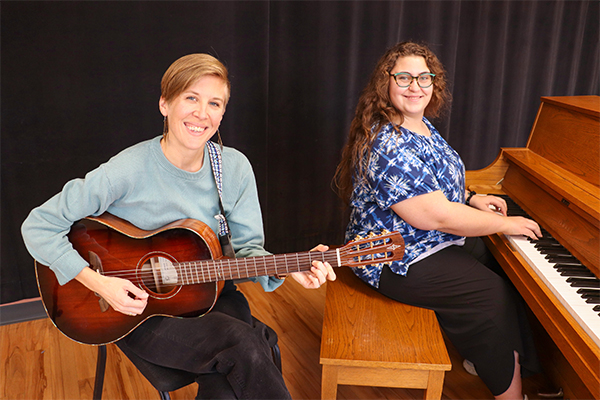
Feltz, a music therapy major from West Chester, Ohio, partnered with faculty mentor Joy Willenbrink-Conte for her summer fellowship. Willenbrink-Conte, an assistant professor in the UD Department of Visual and Performing Arts, coordinates UD's music therapy program. Their project received the donor-supported Stones of Hope Award from the UD College of Arts and Sciences.
According to an Ohio Department of Health study, Montgomery County had the highest ratio in the state of pregnancy-related maternal deaths to live births between 2008 and 2016, with roughly 20 maternal deaths for every 100,000 live births.
"We are supporting efforts already in place in Dayton to improve outcomes for Dayton pregnant individuals and parents, and bolster the health and well-being of folks here in Dayton," Willenbrink-Conte said.
Music therapy, in which music is incorporated into a health-oriented therapy process, is a recently licensed healthcare field in Ohio. Music therapists are trained, certified healthcare providers.
"Music therapy could be facilitated in a medical or mental health hospital, elder care, prisons, outpatient clinics, schools or even a university counseling center," Willenbrink-Conte said.
Feltz has been able to gain hands-on experience in her field in her first two years at UD.
"An example of my practical work with music therapy from last semester was with older adults in a nursing home, particularly a memory care unit," Feltz said. "We engaged in group music therapy to support quality of life, doing a lot of recreation. I would bring in a song and we would all sing it together. It not only urges them to engage in the community around them but also improves their memory retention."
Music therapy can be implemented into treatment in other ways.
"The music therapist is designing experiences involving singing, playing instruments, writing music, listening to music and oftentimes there is discussion involved like standard verbal therapy," Willenbrink-Conte said.
In her project proposal, Feltz said research indicates music therapy has a positive impact on prenatal, perinatal and postnatal maternal health outcomes.
“Music therapy has been found to decrease pain and anxiety during labor, especially during the first stage," she said.
Feltz and Willenbrink-Conte's summer research emphasized a sustainable and practical approach to their work with the community. They organized focus groups, developed surveys and other outreach to engage with community partners, and gathered stakeholder perspectives.
Willenbrink-Conte said they wanted to determine, "Does the community want what we have to offer and can we integrate it with ongoing projects and initiatives? Like, will this actually benefit people?"
So far, the responses have been "overwhelmingly" positive.
"We learned a lot about what will make it accessible for the community," Feltz said. "A big part of that for us was understanding we don't know everything, right? I have my own lived experiences and interactions with the world, and that is absolutely not what anybody else's is."
Feltz has been a practicing musician most of her life, but music therapy draws on knowledge well beyond music.
"For music therapy, being able to sing and play in a variety of musical styles is important, because our clients will prefer a variety of things," Feltz said. "Personally, I have sung in a Catholic Church choir most of my life, so I enjoy liturgical music in many styles. Otherwise, I've sung some classical art songs and jazz standards recently, and I am singing a piece I wrote in a singer-songwriter-pop style this semester as well."
Feltz plans to present her research April 21 at UD's Brother Joseph W. Stander Symposium. She also hopes to present with Willenbrink-Conte at the 2027 Annual Great Lakes Region of the American Music Therapy Association conference.
To finish her undergraduate studies, Feltz plans to apply for an internship and complete her required clinical hours to become a board-certified and licensed music therapist.
The UD Dean’s Summer Fellowship program provides UD students with opportunities to conduct summer research in any academic discipline under the guidance of a faculty mentor with funding from the UD College Dean’s Fund for Excellence.
The Stones of Hope Award is awarded to students participating in summer faculty-mentored opportunities where they develop and apply skills in service of creating a just society. This fund honors Dr. Martin Luther King Jr.'s "I Have a Dream" speech, in which King invoked the idea of people becoming a stone of hope.
Photo: Joy Willenbrink-Conte and Annabeth Feltz