Odor and emotions may be more closely linked than once thought, University of Dayton senior Dhana Misquitta discovered during a summer research project.
Misquitta, a psychology major from Pittsburgh, began a remote study in May with faculty mentor Julie Walsh-Messinger, associate professor of psychology and director of the Psychopathology, Personality and Affective Science laboratory at UD.
Her study was supported by the College of Arts and Sciences Dean’s Summer Fellowship program, which provides students opportunities to do research under the guidance of a faculty mentor with funding from the College Dean’s Fund for Excellence.
Misquitta focused her project on the connection between olfaction, one's sense of smell, and theory of mind, one's ability to understand the mental states of themselves and others. This area of research is used for understanding many neurotypical conditions including schizophrenia, autism, Parkinson's and Alzheimer's disease.
Walsh-Messinger researched and published work regarding olfaction and theory of mind before the pandemic paused her study. She suggested Misquitta participate in the Dean’s Summer Fellowship program and use her data from 2018 and 2019 to conduct her own study.
Misquitta began her project by conducting a literature review. Two of the articles included were written by her mentor.
After conducting the review, Misquitta developed hypotheses to test based on the research.
“I hypothesized that a significant correlation would exist between college students' ability to identify different scents and their theory of mind ability,” Misquitta said.
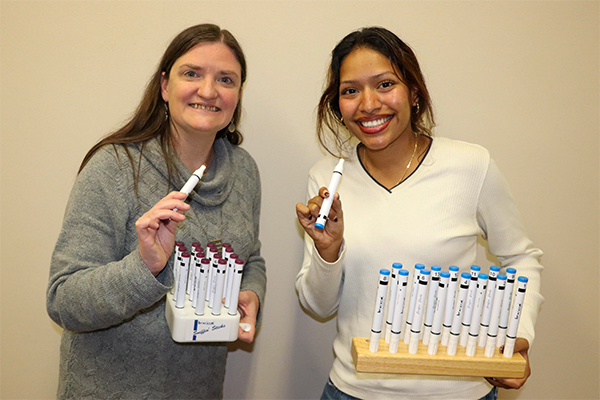
One tool that is widely used for experiments in olfaction are smell detection batteries, according to Misquitta. In her study she used a blue odor detection battery, which is widely used, as well as a purple battery, which is newer and less tested. Each battery features a different set of 16 highly recognized scents that are used to test one’s ability to detect odors.
Misquitta’s project had unexpected results. She found a significant correlation existed between the test that measured students’ ability to read emotional states and their ability to identify odors with the purple battery, but not with the blue.
Misquitta could have stopped there, but she wanted to dive deeper.
“I always asked myself, what is the ‘why,’” she said. “Being curious can lead you down different paths. We could have stopped, but that ‘why’ always leads me to new questions and paths.”
Walsh-Messinger said they didn’t have to pivot.
“We had already done what we had to do, but Dhana was so interested in making sense of what was going on," Walsh-Messinger said. "She shares my interest in data and results and how to make sense of it all.”
Now, Misquitta’s project took on a new challenge — to figure why two batteries created different results.
Misquitta discovered new conclusions around the use of odor detection batteries. She found many young adults no longer recognize some of the odors included in the blue battery that they did nearly 30 years ago, such as anise or turpentine.
Misquitta said there is a need for more research in this area.
“With more studies on this, especially in the United States, it could help us determine if neurotypical people could benefit,” she said.
Misquitta and Walsh-Messinger are still working with the data; Misquitta will present her findings at UD’s Brother Joseph W. Stander Symposium during the spring semester and hopes to also present the findings in Chicago at the Midwestern Psychology Association annual meeting next spring.
Misquitta also is working on a manuscript to publish her findings. Walsh-Messinger said they hope it will be ready for peer review by May 2027.
After graduation Misquitta plans to continue her education. She is applying for clinical psychology graduate school programs and hopes her experience with this project will set her apart from other applicants.
“This project has given me insight into both the research side and clinical side of things within the community,” Misquitta said. “I am correlating what I have learned from classes and internships with the real world.”
Walsh-Messinger agreed that Misquitta’s participation in the Dean’s Summer Fellowship would help in her future endeavors.
“I think the Dean’s Summer Fellowship is an excellent opportunity to get hands-on experience through various parts of the research process, and students create a stronger relationship with a faculty member which helps students who are interested in graduate programs,” Walsh-Messinger said.
Misquitta attributes her success with this opportunity to the leadership and guidance from her mentor.
“She was really helpful and supportive throughout the whole process. Sometimes she pushed me to do things on my own, but I always knew I could go back for her feedback," Misquitta said. "She is just so passionate about this area of research.”
Photo: Julie Walsh-Messinger and Dhana Misquitta with odor detection batteries.