University of Dayton senior Christian Clark did not start his college career at UD. After the Modern College of Design closed in June, he chose UD as his next step toward earning a bachelor’s degree in graphic design.
Megan Gabrielson didn’t start at UD, either. Originally, she majored in nutrition at another school but felt the program was not the path for her. She then made what she called her “best” college career decision so far and transferred to UD's graphic design program where she is now a senior.
Though UD was not their “Plan A,” both students have found a creative purpose in the advanced typography course taught by Misty Thomas-Trout, associate professor and area coordinator of graphic design.
“She does a very good job of keeping us motivated and inspired, especially with the projects. I feel like I am never bored in that class,” Gabrielson said.
Currently, the students are working on typographic posters featuring letters from Dayton native Paul Laurence Dunbar, one of the first Black American poets and novelists to gain national attention.
The posters will be on display for a public exhibition from Nov. 23 to Jan. 1 at the Index Gallery at The Hub in downtown Dayton. An opening reception will be held 4-6 p.m. Friday, Nov. 20, at the gallery, with food and special musical performances by Minnita Daniel-Cox, professor and vocal area coordinator in the UD Department of Visual and Performing Arts, and David Sievers, lecturer in voice and vocal performance ensemble.
Thomas-Trout developed the project after studying Dunbar’s career during her research in the Dunbar faculty development cohort in 2022 and initially funded the project with her money.
Now in its fourth year, the project is titled, “I Am, Words That Remain, Paul Laurence Dunbar: P.S. I Know Why the Caged Bird Sings!” It receives University funding through the Experiential Learning Innovation Faculty Fund. The grant covers catering, printing and production costs.
For many students, this project is their first encounter with Dunbar. Born in 1872 to parents who had been enslaved, he reached Black and white audiences with his writings despite the racist sentiment of the era. He also was notably a contemporary of the Wright brothers.
“It is imperative that students learn who Dunbar was and what American culture was like at that time, and the direct connection to Dayton, Ohio,” Thomas-Trout said. “They need this deep understanding so they make intentional visual decisions on their poster that does not perpetuate any harm.”
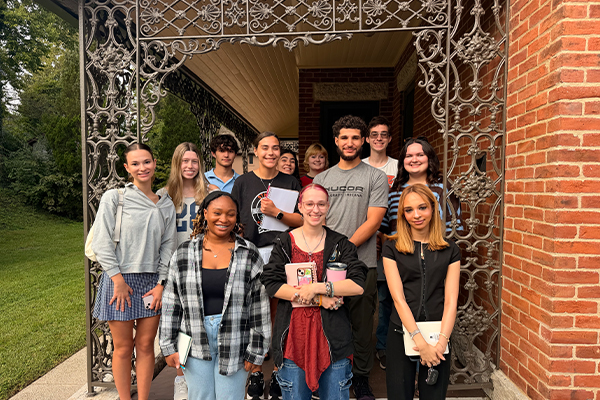
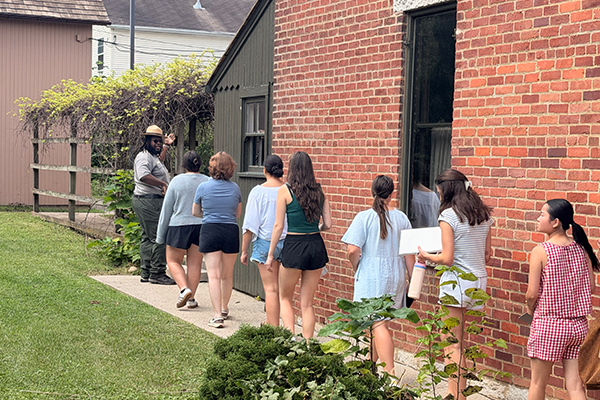
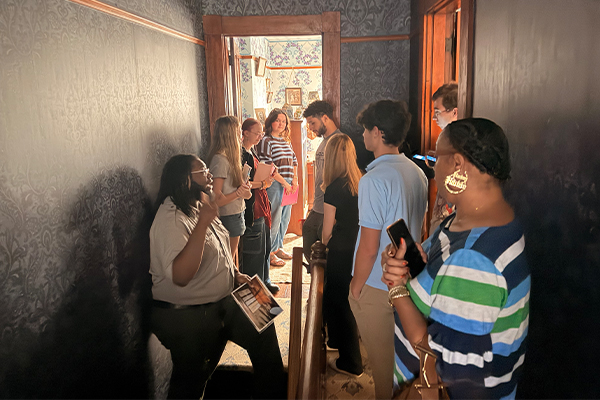
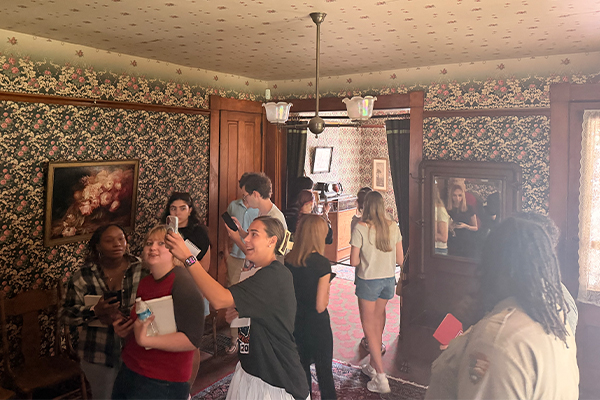
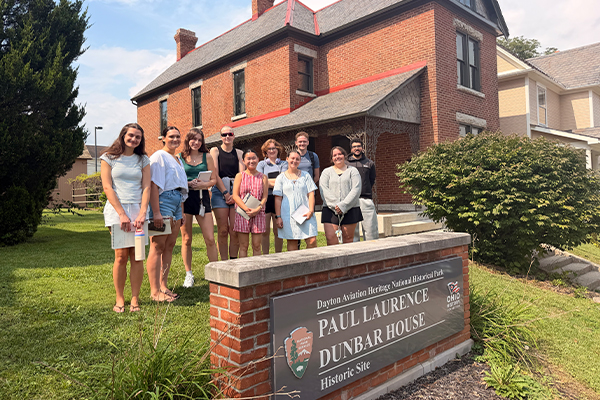
On Sept. 17, students began their projects at Dunbar’s historic home in Dayton, part of the National Park Service’s Dayton Aviation Heritage National Historical Park and the Dayton Aviation Trail. They used this time to collect information visually by observing the architecture, touching certain surfaces, taking photographs and making sketches.
Clark recalled the immersive visit, noting the ornate wallpaper and how well the house had been preserved. He took many photos inside the house but felt drawn to an image of ravens on the cover of a collection of Dunbar’s poetry.
Clark related it to his assigned letter, in which Dunbar writes to Frederick Douglass about mental health struggles caused by gossip and backlash in Dayton. Dunbar was frustrated that some did not approve of his literary ambition and that locals refused to hire him.
“Ravens are usually depicted as evil or mean-spirited animals,” Clark said. “So, with having a letter based on people being evil toward Dunbar, I found a way to take the words from the letter and change it into imagery of having the ravens scream at Dunbar.”
He described his poster as “collage style,” built from photos of the birds at the Dunbar house, which he scanned into Photoshop and edited.
Gabrielson remembered finding inspiration in the upstairs bathroom and being moved that Dunbar’s toothbrush had remained, just as his mother, Matilda Dunbar, had left it after he died in 1906.
The bathroom featured tile with ships printed on it, which she connected to her assigned letter in which Dunbar is on a steamship and writing to his mother. In the letter, he updates her on his sea voyage to reassure her and express hope for his future.
Per project guidelines, the posters must feature an element of handmade imagery, so Gabrielson painted a watercolor steamship in the same style as the tile work. She used calligraphy to highlight certain lines of the letter and scanned her painting into Photoshop to use as a background.
At the Nov. 20 reception, Daniel-Cox will perform poems, including When Malindy Sings, Life, We Wear the Mask, When Dey 'Listed Colored Soldiers and more.
“I'm intensely proud to see the legacy of Paul Laurence Dunbar introducing place-based and community-oriented learning into our curriculum,” she said.
Photos by Misty Thomas-Trout.