University of Dayton sophomore Michael Philip initially planned to study water sanitation during his 10-week summer research experience in Kenya, but his observations on the ground shifted his perspective.
“Once you go over there, you realize there are much bigger problems than water sanitation,” said Philip, a pre-medicine major from Dayton. “I realized all the health care workers were burnt out and exhausted.”
Philip was one of six students to take part this summer in the UD Human Rights Center’s Kenya Applied Research Practicum; a work-based, cultural immersion experience that gives UD students firsthand research and fieldwork opportunities in an international setting. The students worked with Dandelion Africa, a community-based organization run by Kenyan women that focuses on addressing barriers to women’s health and economic well-being in rural areas.
“When I got there, I was able to see what kind of resources Dandelion had and how they practiced medicine and how culture and barriers affect access to different things,” said Kadence North, a senior pre-medicine major from Toledo, Ohio.
North, who aspires to be an OB-GYN, focused on patients and researched family planning practices. Philip chose to study providers and examined health care policies and working conditions.
 Now in its fifth year, the practicum brings four to six UD students to Kenya each summer to conduct individual research projects based on community-identified needs. Past research projects have included climate change, electoral integrity and gender-based violence.
Preparation began during the spring semester with a "Human Rights and Development in Africa" course, where students learned about development issues in Africa and developed research proposals, as well as a mini-course on intercultural competence. They were taught and supported by Satang Nabaneh, an award-winning African legal scholar, elected African Union human rights expert and human rights practitioner, who recently was appointed to a newly established professorship in transitional justice and human rights at UD.
Students also received support while abroad. Dandelion Africa assigned a research mentor to each student to support translation and outreach while ensuring their research remained community-engaged.
“We were always very well cared for,” North said. “We had clean water, food, beds, shelter and so much support from the Dandelion Africa staff. They made us feel incredibly welcomed and made the experience so enjoyable.”
After North arrived in Kenya, she observed transportation and access to medical resources were large obstacles for women; but factors like the cost of medicine, gender role imbalances and the stigma surrounding contraceptives also caused difficulty.
North also observed how internalized gender norms can surface in everyday spaces. During a visit to a local primary school, she heard a teacher advise young girls to modify their behavior and dress to avoid unwanted touch.
“This observation highlights how victim-blaming attitudes are often reinforced across generations, and why comprehensive gender-based violence prevention remains vital,” Nabaneh said.
Much of Philip’s research involved attending health care conferences to ask questions about policy and working conditions. He found departments were extremely short-staffed, and sometimes a single nurse was in charge of multiple departments. Philip also examined community engagement and found people in rural areas were skeptical of mental health. In addition, he found psychiatrists were severely overworked, resulting in burnout and resentment toward the field of mental health.
Students, however, got a chance to step away from research and enjoy nature. The trip included a stay at Fig Tree Camp, on the banks of the Talek River, followed by a safari in the Maasai Mara National Reserve to observe regional wildlife. North and Philip remembered seeing one of every African animal, except a rhino.
 They also lived in the community. While they mostly resided in Sarambei, a village in Kajiado, Nakuru County, Kenya; they spent three weeks living at Dandelion Medical Center Kilimanjaro near the Kenya-Tanzania border; which utilizes sustainable, converted shipping containers and off-grid water conservation systems.
North plans to continue studying power dynamics in health care. Philip and another UD teacher education student are working on a toolkit to help Dandelion Africa refine its approach in supporting the mental health of health care workers.
“You can’t help health care workers without helping the community,” Philip said.
Dandelion Africa will use the students’ research to inform better practices and influence the local government or medical community, as well as engage donors. Students will discuss their experiences and findings at the Raymond A. Roesch, S.M., Social Sciences Symposium in November and the Brother Joseph W. Stander Symposium in the spring.
“This summer's Kenya Practicum embodied what it means to be a university for the common good,” said Natalie Florea Hudson, professor of political science and Human Rights Center executive director. “Our interdisciplinary team of students made important contributions to our partner, Dandelion Africa. I am so grateful for this group of young people. They made UD very proud.”
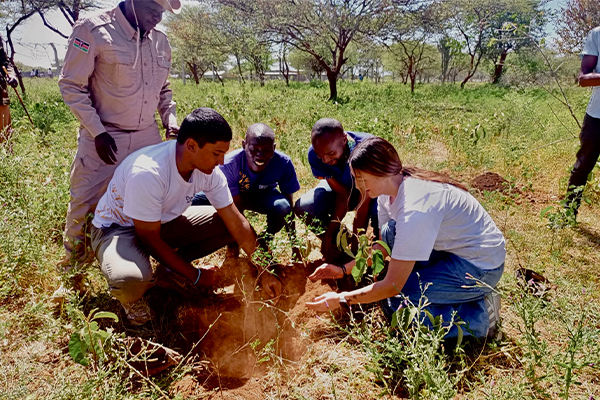
Top photo: Kenya Applied Research Practicum students planting a tree during a community environmental event.
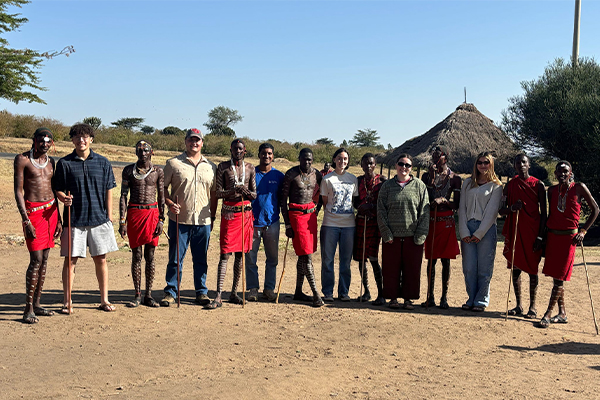
Middle photo: Students visited a Maasai community, where community members shared aspects of their culture and daily life.
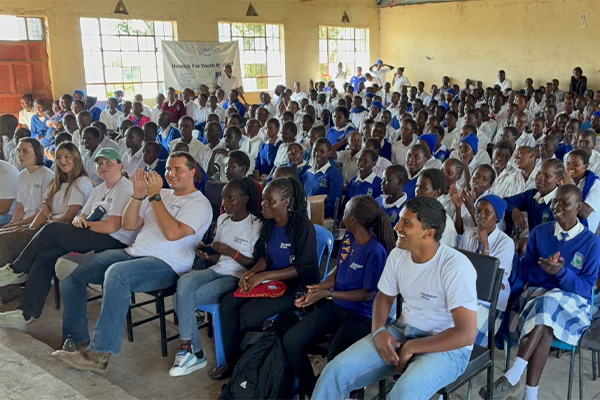
Bottom photo: Students watched young people perform in a talent show for Day of the African Child through Dandelion Africa’s youth program.