Is William Shakespeare too "dangerous" for the modern high school classroom? University of Dayton senior Carly Olson says no.
Olson, an English and young adult education major from Troy, Ohio, explored whether Shakespeare's plays are no longer beneficial to high school students because they "contain sensitive and difficult topics that could be potentially harmful to a teenage audience and readership," according to her project proposal.
Her research, part of her UD Honors program thesis, was funded through the College of Arts and Sciences Dean's Summer Fellowship program.
Olson brought together "close-reading analyses, historical contextual information and pedagogical research on the teaching of sensitive topics in Shakespeare" to show how it can be used effectively. This work will be used in her future classrooms and potentially others.
Her summer research focused on Shakespeare's Othello, a play about a general in the Venetian army who murders his wife after being tricked into believing she is cheating on him. The play is further complicated by the protagonist's, Othello, race as a Black man of Moorish descent.
Olson explored the play with the help of the Folger method, a technique "that focuses on getting students directly engaged with the text," she said. The method comes from the work of the Folger Shakespeare Library in Washington, D.C., which claims to have the world’s largest collection of materials related to Shakespeare and his works.
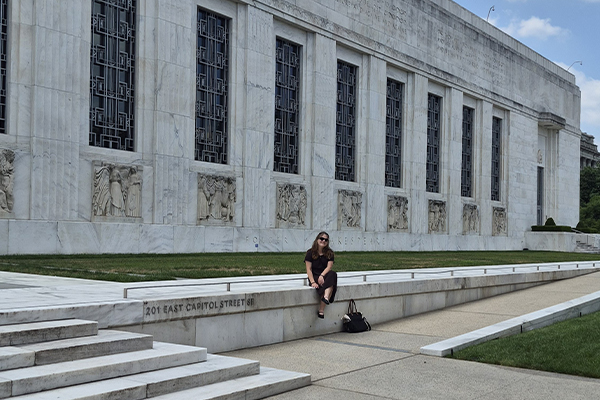
Because of the Dean's Summer Fellowship, Olson was able to travel to Washington and spend an entire day at the library, accessing one-of-a-kind sources for her research.
"I pulled a book down, and it was just like all different literary critiques from when his plays were first being widely published," Olson said.
She also got to watch Farah Karim-Cooper, Folger Shakespeare Library president and former education director of the Shakespeare Globe Theatre in London, give a speech about "different ways you can use the content in those plays to interpret and connect with them," Olson said.
Karim-Cooper is one of the most respected academics studying Shakespeare and his work.
"It was an incredible opportunity to hear Dr. Karim-Cooper's insights," Olson said. "Her talk was an insightful way to kick off my time at the Folger. Her perspective about her own experience with Shakespeare as a teenager impacted the way I thought about my future students over the course of this project."
The Dean’s Summer Fellowship program allows undergraduate students to conduct summer research in any academic discipline under the guidance of a faculty mentor with funding from the College Dean’s Fund for Excellence. Olson completed her research alongside Kirsten Mendoza, associate professor and UD Department of English assistant chair.
Mendoza, who specializes in 16th and 17th century drama, poetry and literature, teaches courses on Shakespeare at UD. She said her goal as a teacher is for students to recognize these works as a part of a longer history and how they connect to contemporary issues. Both goals resonated with Olson when she took Mendoza's course her sophomore year.
"It was just so unlike any Shakespeare classes that I took in high school," Olson said. She cited the "loss of dimension" as her biggest complaint about Shakespeare in the high school classroom. But, these conflicting experiences posed a question for the future teacher: "I'm going to have to cover Shakespeare. So, how do I go about doing that?"
Olson’s summer research project provided the answer. She completed a 31-page research report that includes a usable teaching resource on Shakespeare's Othello, an analysis of Othello in film and literature, and explains how to work with the Folger method. Her research covers topics from the play such as racism, domestic violence, self-hatred and suicide.
"I'm so impressed with the detail and thoroughness,” Mendoza said. “In fact, Carly has inspired me in so many ways. She's thinking about how to navigate these potentially difficult conversations."
Olson will present her summer's work at UD's annual Brother Joseph W. Stander Symposium in the spring.
"I think it's doing a disservice to not study Shakespeare," Olson said. "Part of the reason we say that literature and English are still worth studying and worth engaging with is because it's helpful with your formation of world views and a moral compass."
Photo: Carly Olson at the Folger Shakespeare Library in Washington, D.C.