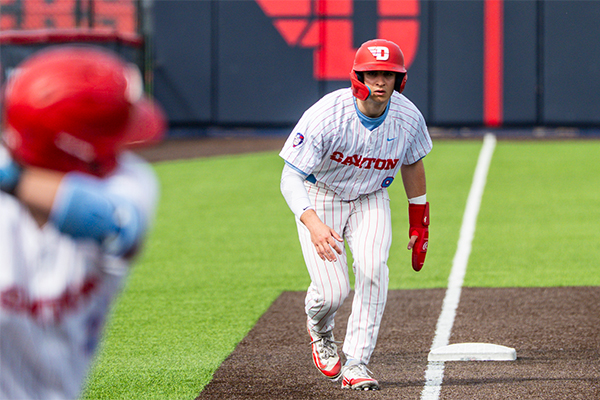
University of Dayton senior Michael Lucarelli was curious about the intersection of mental health and sport.
Lucarelli, a former UD baseball player, spent his summer researching how rhetoric surrounding mental health impacts an athlete's willingness to seek help. The College of Arts and Sciences Dean’s Summer Fellowship program supported his research.
The program provides UD students with opportunities to conduct summer research in any academic discipline under the guidance of a faculty mentor with funding from the College Dean’s Fund for Excellence.
Working with mentor Liz Hutter, associate professor of English, Lucarelli began his project by gathering data from current and former NCAA Division I baseball players across the country.
Lucarelli faced challenges while conducting his research. The athletes he worked with faced rigorous schedules with summer baseball games and collegiate training. There was also a reluctance to open up to him.
“Mental health is extremely personal and especially as men, participants don’t want to show weakness,” said Lucarelli, a general studies major from Marlton, New Jersey.
Despite initial difficulties, Lucarelli found commonalities among participants' experiences. Student-athletes reported use of the phrases “in a blender” or “sped up” to describe teammates experiencing mental health struggles. Athletes who were struggling were encouraged to embrace the “grind mentality.”
Lucarelli said this language is not inherently bad, as it is often used to keep things light or as motivation. However, he found this language creates a culture that does not encourage openness around mental health.
“The ‘grind mentality’ can be positive and helps a lot of people, including myself; but mental health isn't lifting in the gym. It's not an hour of grinding and then it's over; lift ends at the end of the hour, mental health doesn't.”
Although this language is normalized among college athletic teams, that does not have to be the case.
Student-athletes are provided resources for mental health, which often go unused. This happens at the beginning of a season, and team cultures don’t always reinforce those messages.
“So often mental health is talked about to check a box,” Lucarelli said.
Lucarelli found mental health messages and information about resources rely on repetition. Also, close interpersonal relationships, often with upperclassmen and coaches, are necessary for student-athletes to feel comfortable using them. He said open conversations that communicate to struggling athletes that asking for help is okay are more important than the provided resources.
He said the key to changing rhetoric surrounding mental health among teams is to change the culture from the top down. Lucarelli found coaches and upperclassmen play the largest roles in facilitating that culture of vulnerability.
Improving this culture doesn’t always happen in large team meetings. Everyday interactions in the locker room and on the field can be just as impactful, such as when older teammates check on younger players.
“When I was a freshman it meant the world to me when an upperclassman pulled me aside and just asked how I was doing and what he could do for me,” Lucarelli said.
Upperclassmen may forget what it was like to be a younger player, but younger players look to them to set the standard. They decide what makes you “soft” or “weak.”
“Successful players and upperclassmen can redefine what toughness really is for a team,” Lucarelli said.
Coaches contribute to the attitudes surrounding mental health and help-seeking behaviors on a team, too.
Lucarelli, who played baseball at two other universities before UD, said he experienced “both ends of the spectrum” when it comes to coaches. Some cultivated a culture of vulnerability and others actively discouraged it.
Lucarelli’s summer research provided him with opportunities to connect his interests of health, communication and athletics. He credits Hutter as vital to his project.
“Dr. Hutter helped me so much throughout the process and I could not have done it without her. Ultimately we formed a great relationship with each other that will last beyond my undergraduate years.”
The summer research program benefits students and faculty alike.
“One takeaway from this project — and by extension the Dean’s Summer Fellowship program — is learning is reciprocal,” Hutter said. “I am also continuing to learn something new or unfamiliar about the nature of research to create, question and share knowledge.”
Lucarelli, who plans to attend medical school after graduation, said participation in the research program will help him in his future endeavors.
“This experience taught me how to ask better questions and analyze people's experiences beyond the surface level,” he said. “I saw how complicated this situation really is. It's highly variable. Research isn't just a problem and an answer, it can uncover more problems and more answers.”
Photo: Former UD baseball player Michael Lucarelli leading off third base.