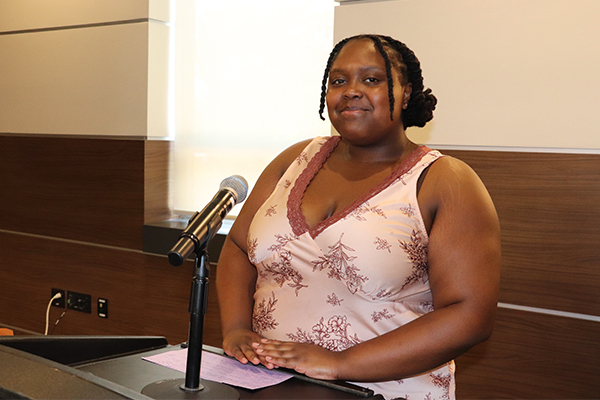
University of Dayton senior Trinity Minus researched womanist theology and Black religious history to show how Black women have struggled with and redefined bodily autonomy over time, specifically in the age of Generation Z.
Minus, an English major from Dayton, collaborated with Cecilia Moore, an associate professor in the UD Department of Theology and Religious Studies, through the UD College of Arts and Sciences Dean’s Summer Fellowship program.
Her project draws upon her 2025 fall semester experience in Moore’s African American religion course, which investigates Black religious history from the 1500s to today.
“Near the end of the semester, I introduced the development of Black womanist theology in the later 20th century,” Moore said.
A womanist is defined as a Black feminist or feminist of color who fights for the survival and well-being of all people, both women and men, centering on community building and intersectionality.
“I felt terrible that I did not have more time to give to womanists, but we had run out of time,” Moore added. “So, when Trinity said she wanted to continue studying womanist theology and to look at it in relation to literature and the current challenges, hopes and goals of Generation Z women, I was amazed and I thought it was a tremendously rich line of inquiry.”
The Dean’s Summer Fellowship program allows undergraduate students to conduct summer research in any academic discipline under the guidance of a faculty mentor with funding from the College Dean’s Fund for Excellence.
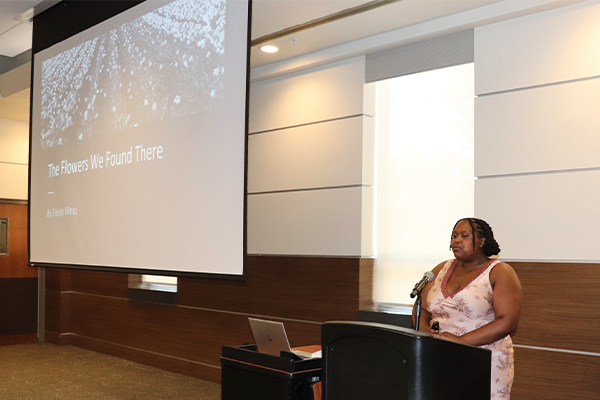 Minus presented her findings in September at UD’s summer research symposium, with plans to present in April 2027 at the Brother Joseph W. Stander Symposium.
Moore said her role as mentor was to simply listen and advise. She said Minus was particularly interested in the role religion has played in the lives of Black women.
Minus began by determining the texts she wanted to study. She and Moore discussed a range of books by womanist theologians, Black women writers from the early 1800s to the present, and other historical works that would help visualize the continuities and changes in Black women’s experiences.
“There are a lot of options out there and I wanted to find ones that I felt would be able to give me introductory information into women's theology, but then also touch on the Black female experience,” Minus said. “Luckily, a lot of them crossover very well.”
Minus said the Black woman’s experience is unique and becoming more complex as technology advances and more nuance is brought into relevant conversations. Since Minus’s project focuses on Gen Z, she found the existing data to be limited. She said society still has time to develop these findings and possibly find a conclusion by the end of this decade.
“That’s when the oldest members of Generation Z will cross into their 30s and begin to evaluate their own personal experiences,” she said. “It’s going to be something that has to be born out of you, not something we can truly take from someone else as a template and apply to our own lives. It’s going to have to be much more organic.”
Minus hopes her research and that of others will lead to people being more open to learning about something that might make them uncomfortable.
“I think that has a lot to do with the experience of being a Black woman in America, attending a primarily white institution and a Catholic university,” she said. “All of that has moments of discomfort, but that's usually a moment of learning.”
For Minus, continuing to learn is central to her understanding of womanism. She hopes her research encourages others to do the same by reading and listening to the experiences of Black women.
In addition to her Dean’s Summer Fellowship stipend, Minus received the donor-funded M5 Family Foundation award, which is awarded to students pursuing semester- or summer-long experiential learning opportunities in the humanities and the arts.
Moore said opportunities like the Dean’s Summer Fellowship program provide students with resources that allow them to devote time to deep reading, conversation, exploration and writing; which might not be as easily accessible during the regular semester.
“Students get some insights into all the work that goes into producing a well-researched, thoughtful, useful and carefully crafted piece of scholarship,” Moore said. “It can help them make important decisions about how they would like to use their time, their intellects and their other gifts in the future. Hopefully, students like Trinity who have these experiences doing funded summer research will decide to pursue higher studies, especially in the humanities, because we really need them.”
Photos: Trinity Minus presenting at UD's summer research symposium.