Perceptions: Of sheep and ships and such
From Homer's Odyssey to talking movie sheep detectives, UD Magazine's editor emeritus, Thomas M. Columbus, reflects on why the willingness to wander off-topic might just be what keeps us human.
When I mentioned to my younger colleagues (well, by this point all my colleagues are younger) that I might write about sheep, they were respectfully silent. Admittedly, 40-50 years ago I also probably would not have considered writing about sheep.
In high school, coming from a decidedly urban background, I certainly did not entertain writing about sheep. Indeed, I had not planned out my life in the detail some young people do — this kind of degree, that kind of first job, building a career, finding a soulmate, raising a family, all in order. In those years, I did find my soulmate, and we lived happily together for half a century. The rest evolved.
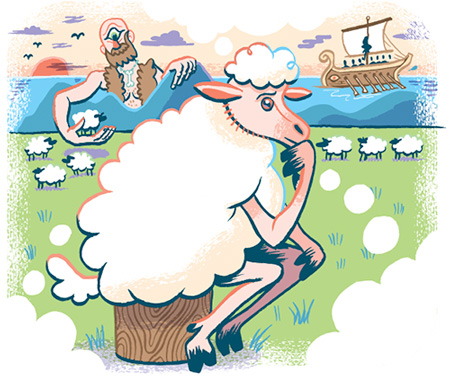 As close as I had in high school to a career goal was thinking that someday it would be cool to translate The Odyssey. Many of today’s parents might be aghast at something so impractical; mine let me head off to a liberal arts education, whose first two years had substantial Latin and Greek. I, however, then majored in something other than classics — English, more practical in the sense I could still study literature but would not have to look up as many words. As for jobs, one could always fall back on teaching in a Catholic high school or working on a suburban newspaper. (Note: Job markets can rapidly change.)
But, I digress.
I believe, however, in the value of digression. If one wants to avoid digression, one can live in the cut-and-dried, question-and-answer world of AI. Accept what AI says and move on. Don’t think. Don’t explore.
Be a sheep. (I’m on topic now.)
Being a city boy, I actually don’t know if real sheep are timid and easily led or just acquired a bad rep for that. In a movie I saw this year, The Sheep Detectives, many of the characters, being sheep, had to confront this stereotype. Since they could talk and think, they had distinct advantages over real-world sheep. Having studied a bunch of Latin and Greek and English literature, I don’t have a problem with sheep that think and speak intelligently. Just imagine if more humans did that.
Having studied a bunch of Latin and Greek and English literature, I don’t have a problem with sheep that think and speak intelligently. Just imagine if more humans did that.
To digress again, I also saw a movie with talking toys — Toy Story 5. They could think, too. And be sad; their human friends had abandoned them. Viewers shared this sadness in a scene where the toys looked over rooftops and, through bedroom windows, saw the faces of formerly imaginative children mesmerized by glowing screens. Recently, in real life, I saw in a coffee shop a father and two small children waiting for their order; the children were staring at what their father was holding — a printed copy of the Wall Street Journal. He was reading aloud to them. Let us rejoice and be glad.
Back to the sheep.
Being detectives prodded them into thought. Sometimes deep thought. One little lamb bleats out very rapidly, “Ooh! I have a question. What’s the meaning of human life if it can all just end one day in the blink of an eye? In fact, why are humans here at all? And who made them? And who made us? And what’s inside a tree and where does the moon go during the day?”
“What’s the meaning of human life if it can all just end one day in the blink of an eye? In fact, why are humans here at all? And who made them? And who made us? And what’s inside a tree and where does the moon go during the day?”
There was one more question but that, having to do with the detective story plot, would require a spoiler alert.
Later in the film, a lamb coming to a church is told by an older sheep that
God lives there. And that God is a shepherd. “Our shepherd? No. Because he’s also a lamb. And he’s also invisible. … And he’s made of bread. … And they eat him on Sundays.”
“Poor God.”
The sheep in The Odyssey don’t talk. Besides being raised by a one-eyed giant who is a son of Poseidon (the sea god) and eats people, they have their routine disturbed by this guy Odysseus, who destroyed a holy city and is having a hard time getting back to his wife, who holds the world record for slow weaving. Part of his problem is having annoyed Poseidon, and he needs to cross the sea to get home. Luckily, the goddess Athena is there. In the book, she is very active. In the movie, she just seems to stand calmly by his side, looking pretty.
Back to digressions from sheep — while watching the movie, instead of intently studying Charlize Theron’s embodiment of Calypso, I was wondering what she was doing giving him lotus leaves. In Homer’s story, they came from the lotus eaters who gave them to Odysseus’ men, making them apathetically forgetful of home and family. I guess something had to be cut.
In any case, Odysseus stays with Calypso for seven years, forgetting his wife and his long-gone men. In the movie, the cause seems to be the narcotic flower and Charlize Theron. Homer’s Calypso, however, is more than a beautiful supplier of drugs; she is the daughter of a Titan. (Titans controlled the world until Zeus and his buddies unseated them.) This semi-divine nature allowed her to offer Odysseus, if he stayed with her, immortality.
In book and movie, he eventually turns her down and, not being a timid sheep, returns to Ithaca and gains vengeance. Is it because the ne’er-do-wells there want his wife and kingdom or because they do not give hospitality to a stranger (the stranger being Odysseus disguised as a beggar)?
But that’s another digression.
Illustration by Dan Zettwoch.
A version of this article appears in print in the Autumn 2026 University of Dayton Magazine, Page 62. EXPLORE THE ISSUE — MORE ONLINE