Can Congress clean up the mess in college sports?
Legislators try to confront confusion, lawsuits, conflicting rules, unfettered transfers, soaring spending for a couple of sports — and uncertainty for the rest.
A year ago, UD Magazine had a story on a bill in Congress to clear up the mess in college sports. And this issue does, too. One hopes it’s not becoming an annual event.
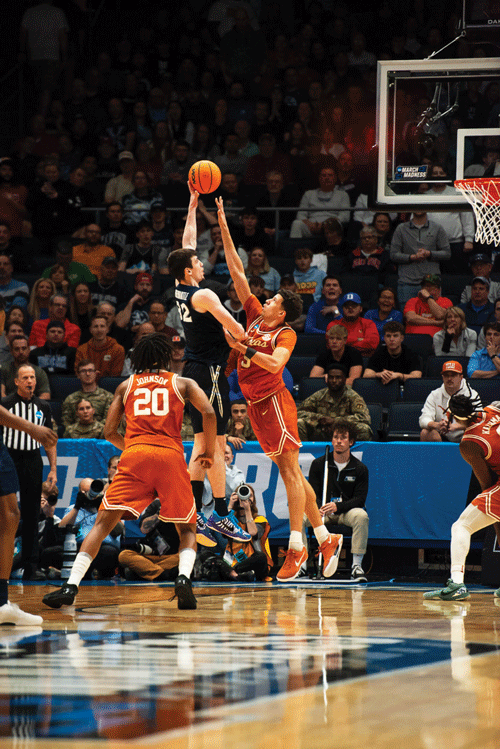
While groups and interests bicker, UD does have a position.
“It’s clear that in a national competition, you can’t have a patchwork of rules from state to state,” said Neil Sullivan, UD’s vice president and director of athletics.
He noted that there is some opposition to federal involvement, but that the federal government has been involved in higher education in many ways — the GI Bill, research grants and student financial aid.
Key issues, Sullivan said, include enforceable transfer rules, an enforceable spending cap, regulation of agents, age-based eligibility and rules for academic eligibility. The Senate adjourned in August without action.
It didn’t take action by Congress for the NCAA Basketball Tournament to announce in April it will expand to 76 teams, with the result of Wichita, Kansas, joining Dayton as an opening-round site. Each city will have three games on each of the two days.
“We’ve long supported expansion. When the tournament became 64 teams,” Sullivan said, “there were 282 D-I men’s basketball teams. Now there are 365.”
In 1985, when the tournament first expanded to 64 teams, 23% of D-I schools made the tournament; now it will be 20%.
In sports that are officially professional, 40% of MLB teams make the playoffs, 44% of NFL teams and half of NBA teams (two-thirds if you count play-in games).
“The college system was not designed with mega-leagues in mind,” Sullivan said.
One of their teams can have 12, 13, 14 losses and make the tournament because of actual and perceived strength of schedule. Also, more teams and large leagues reduce out-of-conference games. Fewer games with teams in other conferences makes comparisons harder and tournament selection more difficult.
Photograph by Maggie Endres ’26.
A version of this article appears in print in the Autumn 2026 University of Dayton Magazine, Page 26. EXPLORE THE ISSUE — MORE ONLINE