Answering the call of duty
In 1943, Vincent J. Floriani was one of 250 recruits from the Army Specialized Training Program sent to the University of Dayton’s campus. His son, Frank Floriani ’72, recounts his journey.
On a brisk fall morning in 1943 at the University of Dayton, walking across campus would mean seeing students smartly dressed, wearing slacks and pleated skirts — just to attend their regular classes.
But given that World War II was in full swing, it would also mean spotting the uniformed young men of the Army Specialized Training Program who arrived in August, dressed in the standard U.S. Army enlisted attire of olive drab wool service uniforms and garrison caps. The ASTP was a U.S. initiative designed to prepare selected individuals for combat through advanced training and collegiate education.
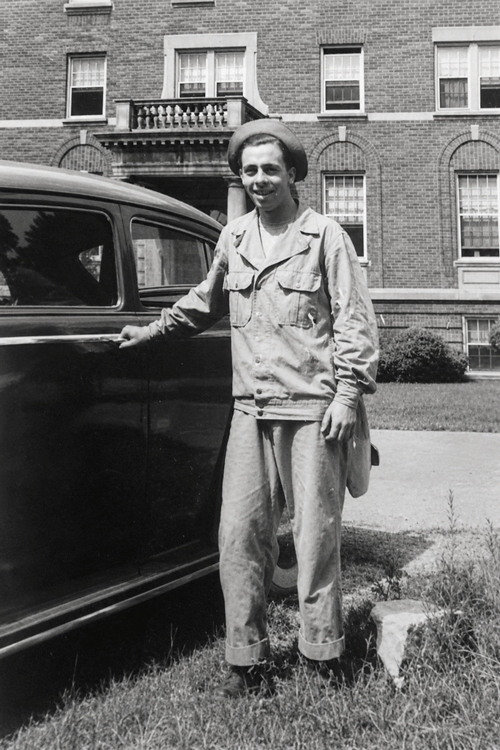
Vincent J. Floriani was among them: a young man from Reading, Pennsylvania. Drafted for combat, Floriani was sent to UD at 19 years old by the U.S. Army, explained his son, Frank Floriani ’72.
“He was a patriot,” Frank said. “When there was a call to duty, he answered.”
Just a year prior, the Secretary of War had lowered the draft age from 20 to 18, meaning a younger pool of American men would be called to serve in the war that had no clear end in sight.
To placate professors whose classrooms would now be emptier, and to ensure recruits were professionally skilled, the Army entered into contracts with at least 227 American academic institutions for training.
Vincent and the other 249 ASTP cadets lived in Alumni Hall, dined in the cafeteria at Chaminade Hall and trained physically with football coach Harry Baujan. Their week consisted of 24 hours of classroom instruction, 24 hours of studying, six hours of physical training and five hours of military training.
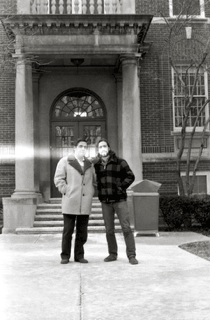
“He always said if you weren’t in uniform [back] then, you looked like a fish out of water,” Frank said.
Their studies spanned 38 weeks and included classes in chemistry, physics, mathematics, geography, history and English, until they were called to combat on March 18, 1944. When they left, only 600 students remained at UD.
From there, Vincent entered service with the U.S. Signal Corps in France after D-Day, joining the personnel tasked with maintaining frontline communications via radio and wire, and monitoring radar.
When the war ended, Vincent settled in New York and transferred the credits he earned from UD to complete his studies at Hofstra University, later returning to higher education to receive a law degree from St. John’s University — all while raising a family. The Nassau County Bar Association later honored Floriani for his 50 years of service.
“The University of Dayton gave him a great foundation for what was to come later,” said Frank.
“I always tell everybody who asks that the Army sent my father [to UD]. And he used it to finish his college education, get a law degree and raise a family.”
That inspiration continued through the family: Frank’s brother, Vincent J. Floriani Jr. ’81, and his cousin, Michael Floriani ’82, were likewise drawn to UD by Vincent’s example. For Frank, the influence extended even further, shaping not only his choice to become a Flyer but also his decision to pursue a career in law, following the path his father had taken after the war.
Continuing his father’s Flyer legacy remains deeply meaningful to Frank.
“It’s a huge sense of pride that he went there,” Frank said. “I always tell everybody who asks that the Army sent my father [to UD]. And he used it to finish his college education, get a law degree and raise a family.”
Photos courtesy Frank Floriani '72.
A version of this article appears in print in the Autumn 2026 University of Dayton Magazine, Page 47. EXPLORE THE ISSUE — MORE ONLINE