At twenty-two, newly graduated and not yet a law student, I arrived in Banjul, The Gambia, to spend the summer at the Institute for Human Rights and Development in Africa (IHRDA). As a pan-African NGO, IHRDA advances human rights through strategic litigation, research, and legal education within the African regional human rights system. I contributed legal research and drafting to proceedings before the African Commission on Human and Peoples’ Rights, gaining firsthand insight into how human rights claims are developed and argued within a regional framework.
The principal matter I worked on concerned fourteen individuals transferred from U.S. immigration custody to Equatorial Guinea under a covert bilateral agreement, through which the United States paid the Equatoguinean government $7.5 million to accept deportees removed from U.S. territory. All fourteen had previously received protection from U.S. immigration judges against return to their countries of origin, where they faced persecution or torture. Human rights reporting from within Equatorial Guinea documented arbitrary detention, physical abuse, inadequate medical care, and restrictions on legal representation, raising acute concerns about human rights violations such as non-refoulement—the principle prohibiting states from transferring individuals to places where they face persecution. When lawyers attempting to reach the detainees faced intimidation and obstruction, IHRDA and its partners brought the matter before the African Commission to halt further removals and hold Equatorial Guinea accountable.
My research focused on Articles 7(1), 12(3), and 16(1) of the African Charter on Human and Peoples’ Rights, concerning the right to have one’s cause heard, the right to seek and obtain asylum, and the right to the best attainable state of physical and mental health. The complaint presented the Commission with a novel question: how existing Charter protections applied to individuals transferred across borders after having received protection from removal to countries where they faced persecution or torture. With no directly analogous decisions to draw on, I examined prior cases to identify legal principles that could support arguments under these provisions. This required distinguishing the legal principles articulated in earlier decisions from the particular factual circumstances in which they arose, tracing the Commission’s reasoning, and assessing how its interpretations might apply in an entirely new context. I learned the language of law: how to read a legal argument closely, reason from precedent, and make a claim that could withstand scrutiny. Human rights principles may be expansive, but enforcing them legally is exacting.
Ultimately, IHRDA incorporated my research and drafting directly into its formal submission on the merits.
What draws me to international strategic litigation is its capacity to pursue remedies for individuals while advancing broader institutional accountability. I find compelling the possibility that a case grounded in the circumstances of particular people can have consequences extending well beyond its immediate parties. The experiences of those whose rights have been violated, the particular harms they have endured, and the remedies they seek give the legal arguments their purpose and direction. At the same time, the reasoning through which a court resolves those claims can clarify the scope of international obligations, establish precedent for future cases, and strengthen efforts to secure government compliance. In this way, litigation can offer a means of seeking concrete relief in an individual case while shaping the legal standards and institutional practices that determine whether similar violations occur again.
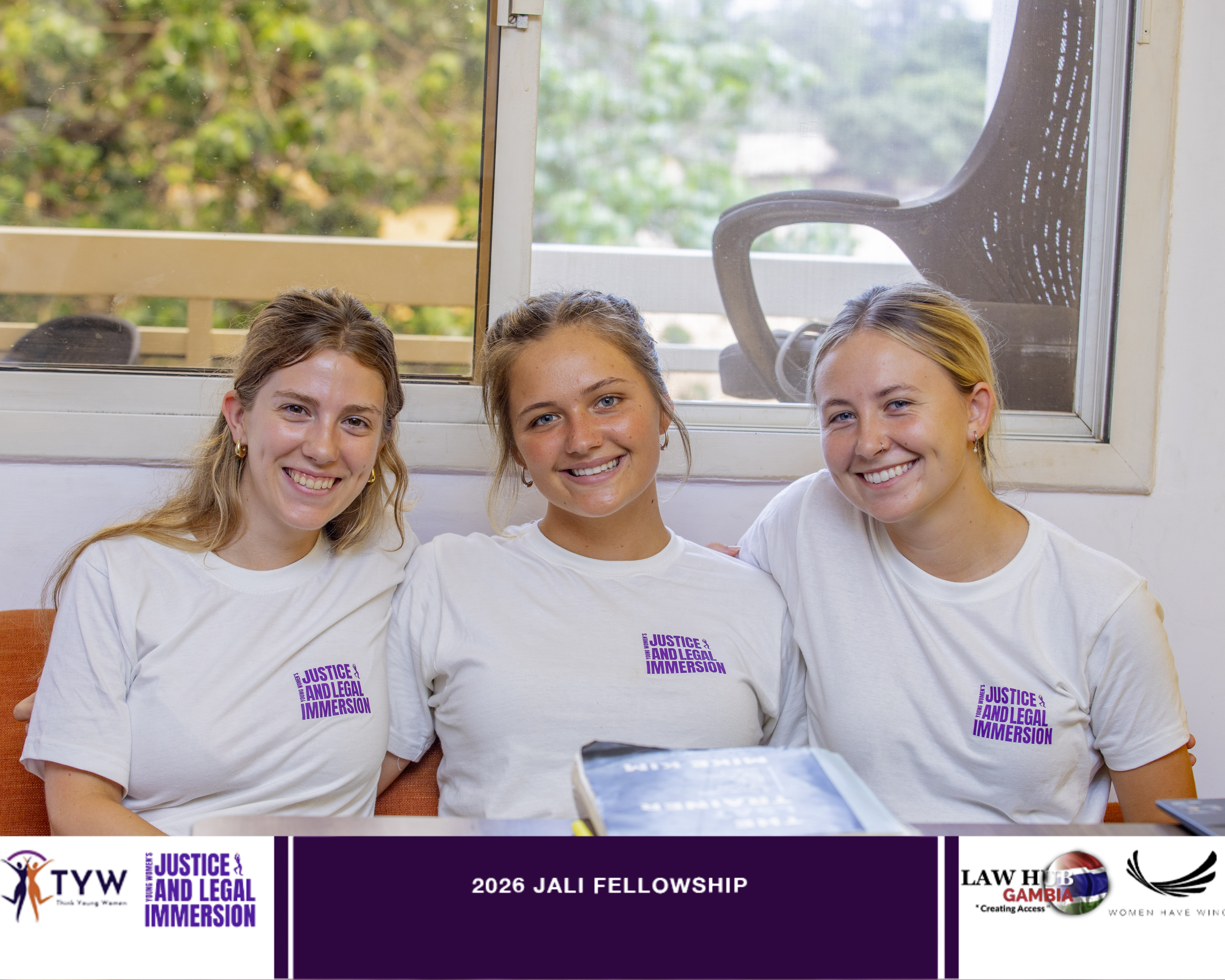
While my work at IHRDA focused on the obligations of states and regional human rights institutions to individuals, I was equally interested in how human rights could be understood and engaged from within local contexts. This concern informed my work in the months preceding my summer in The Gambia, when I worked under Dr. Satang Nabaneh’s leadership to conceptualize and develop the inaugural Young Women’s Justice and Legal Immersion (JALI) Fellowship, in partnership with Law Hub Gambia and Think Young Women. Supported by a Women Have Wings grant awarded to Dr. Nabaneh, I helped develop JALI’s programming framework, pedagogical approach, curriculum, and participant workbook; coordinate its application and selection processes; and synthesize program data for donor-facing reporting. At its core, the fellowship created opportunities for young women to articulate their own understandings of justice, identify the issues most pressing to their communities, and explore how they might engage with the institutions and legal systems intended to address them.
In addition to designing the fellowship and its components, I had the opportunity to act as a core facilitator during the program. I led foundational sessions such as Human Rights 101, introducing fellows to key human rights principles, the African regional human rights system, and The Gambia’s constitutional framework. Equally important, however, was creating space for participants to develop their own perspectives on justice. Through the custom workbook, collaborative exercises, and facilitated discussions, I helped fellows identify local injustices, analyze why they persist, and connect formal legal concepts directly to their own community realities.
This academic foundation came to life through site visits and discussions with practitioners at organizations like the Female Lawyers Association, National Human Rights Commission, Ministry of Justice, the Gambia Bar Association, and IHRDA. Direct engagement with women in law and representatives of human rights and government organizations helped the fellows move beyond abstract frameworks and get to know the real people and places that protect rights. These encounters allowed them to ask direct questions, understand institutional mandates, and see how their local community concerns connect to national and regional protections. Ultimately, these experiences bridged the gap between theory and practice, helping fellows envision how they might actively participate in these legal processes themselves.
My commitment to localizing human rights had long informed my thinking and shaped JALI’s approach. Even so, during a workshop intended to prepare fellows for a professional networking event, I was reminded of the need to continually examine my own positionality as a white, Western foreigner. I introduced an exercise to develop an “elevator pitch” and was met with considerable confusion. In explaining my intentions—to help fellows communicate their interests and aspirations to the professionals they would soon meet—I stumbled over my words as I began to recognize the exercises underlying market logic. An elevator pitch asks a person to distill their interests and ambitions into a persuasive account of their individual value, effectively rendering themselves marketable for professional advancement. There I was, proposing an elevator pitch workshop to a group of young women, none of whom had even stepped foot in an elevator. In a culture far more community-oriented and relationally bound, I caught myself attempting to import a convention shaped by my own professional experiences and treating it as a universally useful tool, without first considering what it assumed or whether it reflected how the fellows understood their own aspirations. Their confusion prompted me to step back, reconsider the exercise, and dismantle the unexamined assumptions I had brought into the room.
The experience reminded me that justice cannot be reduced to making existing institutions more accessible to those historically excluded from them. Localizing human rights requires sustained reflection on one's own positionality and the assumptions embedded in the frameworks and practices one brings into a community. Although human rights aspire to universal protection, people understand injustice, articulate their priorities, and pursue justice through particular histories and relationships. Local communities are not simply recipients of human rights, but partners in interpreting, adapting, and reshaping these frameworks to pursue their own understandings of justice. Centering the experiences and voices of the JALI fellows was one way the fellowship put that commitment into practice.
I left The Gambia grateful to IHRDA and the University of Dayton Human Rights Center for work that challenged me intellectually, introduced me to the practice of regional human rights law, and expanded my understanding of what advancing human rights can entail. Yet the lessons I carry from that summer extend well beyond the work itself. They are inseparable from the people I came to know and the rhythms of daily life I grew to appreciate: women arranging fruit beneath the afternoon sun, taxi drivers speaking about politics with sincerity, young people pursuing their ambitions with energy and tenderness. I recall the laughter, the prayers, the music drifting through evening streets, and the quiet persistence of ordinary routines. Living in The Gambia and building community there gave me a lived understanding of the country, one shaped as much by relationships as by its histories, institutions, and struggles. The gentleness I encountered reminded me that the work of upholding human rights, however technical or institutional its demands, ultimately rests on our relationships with one another. I remain grateful to the people who welcomed me, included me in their lives, and made me feel that I had found a community in a place I had only just begun to know.
Gabrielle Davis graduated magna cum laude and with Honors with Distinction from the University of Dayton in 2026, earning a B.A. in Human Rights Studies, minors in Philosophy, Political Science, and Pre-Law, and academic excellence awards recognizing her as the outstanding student in both Human Rights and Philosophy. In summer 2026, she joined the Institute for Human Rights and Development in Africa in Banjul, The Gambia, contributing to strategic international human rights litigation and legal empowerment initiatives for young women. She currently serves as a Jesuit Volunteer and Right to Counsel Coordinator at the Eviction Defense Collaborative in San Francisco, where she helps tenants facing eviction assert legal defenses and preserve their housing. She aspires to attend law school in fall 2027.