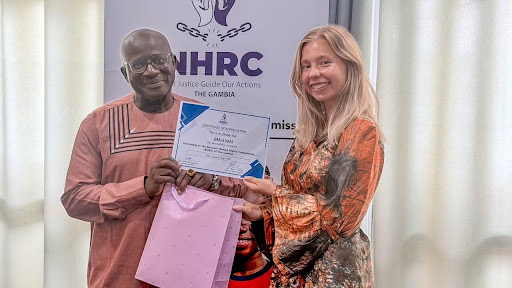
When I got off the plane, I had no idea what to expect. I remember thinking, as I applied for a summer fellowship, that I wanted to have an adventure and experience another culture. I did not really think about it much beyond that. Afterward, looking back, I can honestly say this experience has changed me in so many ways.
Going to university was a big change for me. I was living away from my family and the house I grew up in, having to learn to take care of myself with no one over my shoulder telling me how to do it. I remember freshman year of college, feeling a sense of freedom and learning independence that I had not experienced before. Although I had so much support along the way, learning to navigate a new place was at times scary but also so fulfilling. Interning at the National Human Rights Commission in The Gambia kicked that sense of independence up a notch.
Experiencing a different way of life, where I felt like I didn’t always know what was going on, was really good for me. I tend to like to control a lot of aspects of my life. I like to plan, overthink, and overanalyze, but in this case, a lot of the time the answer to my overthinking was to just be. Be in the moment and be present, because the meeting will start two hours later than I thought. Be in the moment and be okay with adapting when the lights won’t turn on. Take time to talk to people you just met, because what else could be more important than slowing down and making connections?
I have met some of the kindest and most well-intentioned people during my time in The Gambia. It seemed like everywhere I turned, someone was asking if I needed help or checking in on me. I felt such a sense of community while being in The Gambia. There were, however, times when I felt very out of place and almost as if I was an intruder. One thing I learned is that language is not binary. I found that in most conversations, Gambians can easily speak five or six languages in a single conversation. As someone who grew up speaking only one language, I found this to be a fascinating part of the culture. It takes a level of intelligence that I have not yet achieved to flow from one language to the next with such fluidity. It was so interesting to me; however, it often left me out of conversations or in a space where I didn't understand all aspects of the environment I was in. I often found myself relying on other senses, such as body language or tone of voice.
Another of the biggest takeaways from this trip that I will continue to analyze is the gap between laws, policies, and implementation. One of the big projects I worked on this summer was helping to condense the United Nations' recommendation to the Human Rights Commission on ways The Gambia could better uphold the rights of rights holders. Although I found some recommendations about passing new legislation to protect vulnerable groups, most were about implementing existing legislation. This is the tricky part in almost any country, but I had never worked closely with laws and policy before, so it became increasingly apparent throughout my time in The Gambia that implementation is always challenging.
During my time, I also had the opportunity to attend a court case regarding the practice of FGM. A group of Gambians took the issue of FGM to court because they felt that the illegalization of the practice did not allow them to express their cultural freedoms. Before coming to The Gambia, I had heard of this practice, but I did not realize how prevalent an issue it is in the country. FGM is one of the major issues where I saw a gap between law and practice. Even though it is illegal to perform FGM, it is still very common, especially amongst rural communities. The gap between the law and social norms exists heavily in this issue, along with many others that deal with the rights of women and girls.
I found this experience to be a great start in opening my mindset to understanding and learning about human rights issues from a global perspective. Reading and studying these issues does not provide the same insight and understanding as being immersed in a culture where you have the opportunity to talk to people about what their daily lives are like and the beliefs they uphold. I could not think of a better way to explore a new country than to look at it from a human rights lens. The human rights lens allows for an understanding of what the people living in that country truly experience.
Throughout my time, I often felt as though people viewed me as an outsider, even a tourist. In some ways, I guess you could say that, according to my visa, I was a tourist, but the longer I was there, the more weeks I had spent feeling out of place, the more surprised people were that I had stayed so long.
In preparation for embarking on this journey, we had a lot of conversations centered around how to be ethical while abroad in internships, or studying abroad in countries that have negative stereotypes. I think that after this experience, I have learned that one of the most ethical ways to travel is to get to know the people in the spaces you go and learn about the challenges they face, why they face them, as well as all the beautiful parts of their lives that may be very similar or very different than your own.
Grace is a rising senior, majoring in Sustainability with minors in International Studies and Communications. She spent her summer interning at the National Human Rights Commission in The Gambia, located in West Africa.