Going into this summer, I was eager to see where my work would lead me and how it would pan out. I never could have imagined the impact that this summer would have on my life. I was lucky enough to already have a head start on my work, as I had been working on this project with Dr. Nabaneh since last August. Continuing it throughout the summer has helped me not only improve my research and writing skills but also grow as a person.
Over the past year, I have had the privilege of working with Dr. Satang Nabaneh. She is currently working on her book centered on the process of decolonization and its lasting impacts on women’s rights in nations that were previously under British rule. Perhaps one of the most impactful happenings of the twentieth century was the decolonization of Great Britain’s former colonies in Asia, Africa, and the Caribbean. These would include nations such as Sierra Leone, Singapore, Fiji, and many more. The argument Dr. Nabaneh makes in her book is that, in carrying out this process, the British government also imposed major restrictions on women’s rights, which are still evident in these nations today.
When conducting research like this, it is vital to look not just at what women’s rights in these nations currently look like, but also at the history of how they came to be in their current state. To do this, Dr. Nabaneh accessed thousands of documents, letters, telegrams, and articles from the post-colonial period. My job has been to examine, analyze, and interpret these archives in ways that support the claim she makes in the book. The end goal of my work, in particular, is to include a chapter in the book that focuses on the historical context of the issues surrounding women’s rights in these nations today. This is where I left off when I left for the summer and where my summer experience began.
I started by summarizing the main takeaways I gathered from the archives. This would serve as a baseline for what the chapter will discuss and for the book overall. These are the six major takeaways that I got from the research…
- When it came to drafting the constitutions and establishing governments for these newly independent nations, the British were heavily involved, while local officials were often excluded.
- A large portion of the impositions concerned rights related to citizenship, voting, property ownership, and divorce/marital status.
- Occasionally, the British granted some power to local officials, but only when it meant upholding colonial impositions on women’s rights.
- They often used vague language to inconspicuously include clawback clauses, which are provisions stating that certain rights do not apply in specific situations (often when women were involved).
- The governments and constitutions were based on one another, enabling the British to reinforce their policies across these nations.
- The language used in these documents was male-centered, indicating a major lack of concern for women’s rights.
After completing this summary, my next step was coming up with ideas for how to organize this information in the book. I came up with three main ideas on how to do this. Generally, they were all fairly similar in how the information was presented. The question was how to organize it so it would fit into the book as a whole. Based on this, I narrowed the list to the format that best fits this project. Using this format, the chapter is split into two sections. The first part will give background information and explain the historical context of the documents it discusses. The second part would then be where we really dive into how the British imposed on women’s rights, using much of the information gathered in the summary. This part of my experience, in particular, really helped me develop my research and writing skills, as it gave me a firsthand look at the process of converting information and knowledge into something I can share with others.
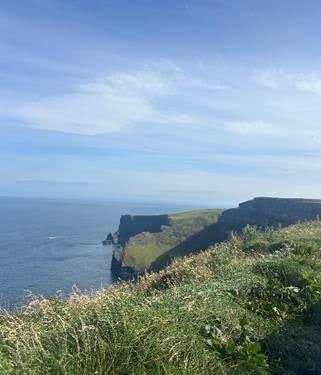
One thing that really added to my experience with this work was the study abroad program I participated in. Throughout June and July, I conducted my research and work from Ireland, where I was studying at Maynooth University. While Ireland was not one of the nations covered by this research, it gave me a unique perspective on why the work we are doing is so important. Like many of the nations that are included in this work, Ireland has a long history of suffering at the hands of the British. This suffering is not a thing of the past, but one that continues on today. The Irish population has never recovered from the “famine.” There is still a part of Ireland that remains under British control. The pain inflicted on them in the past lives on in the people today. Seeing this for myself made me see this research in a new light. People say “the past is past” – and maybe in some circumstances that’s true – but in the cases of nations like Ireland, The Gambia, and many more, this could not be further from the truth.
I gained so much from this experience, and I will forever be grateful for that. If I had to choose one lesson that’s had the biggest impact on me, I’d say it’d have to be that looking at the past – the good, the bad, and the ugly – is how we understand the present and how we navigate moving forward into the future. That is why work like Dr. Nabaneh’s is so important. It shows people why things are the way they are, and how we can use that information to make the world better.
Grace Donnelly is a rising senior at the University of Dayton majoring in History and Human Rights Studies with a minor in Sociology. She is currently a student intern at the University of Dayton Human Rights Center and has worked with Dr. Satang Nabaneh on her book project and the Sounds About Right podcast.