As Halloween approaches and Christians remember the dead on All Hallows’ Eve, All Hallows’ Day and All Souls’ Day from Oct. 31 through Nov. 2 each year, death seems a little more present in rare books and special collections. It’s always there, of course, in inscriptions made centuries ago from long-ago readers and the stamps of defunct libraries. Imagery of memento mori, a Latin phrase and philosophy that can be translated as “remember you must die,” adds haunting symbolism to some of the oldest collection materials in the Marian Library, connecting Christian prayers and practices of living — and dying — well across centuries.
For much of Church history, the Office for the Dead, an overnight cycle of prayers, was central to the All Hallowstide memorials. It is a core text of the medieval Marian book of hours and still used in the Catholic Liturgy of the Hours for All Souls’ Day on Nov. 2. Books of hours sometimes feature memento mori symbols of death, especially personified as a decaying corpse, sometimes carrying a scythe or a clock.
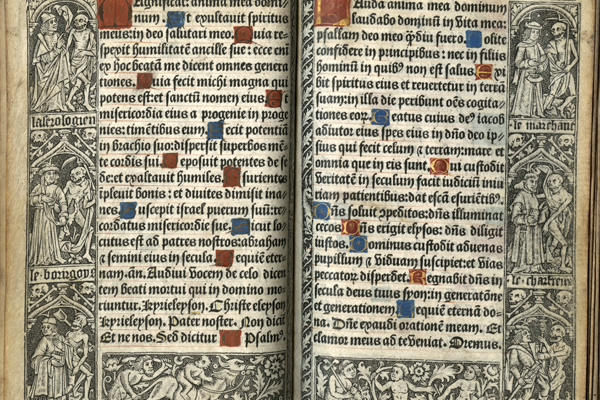
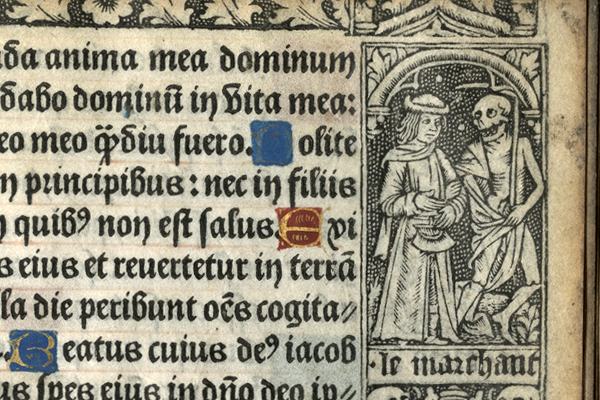
In early 16th-century Paris, Antoine Verard published books of hours (circa 1503 and 1510) with printed borders that surround the text of the Office for the Dead with scenes of a personified death encountering men and women from European society: a pope, a cardinal, an infant, men and women merchants, various ranks of nobility and royalty, and members of different religious orders. In spite of these reminders of mortality, the central text on the page is the Magnificat — Mary’s song of praise and celebration of God’s promise of redemption from Luke 1:46-55 — and likewise part of the evening prayer in the Office for the Dead.
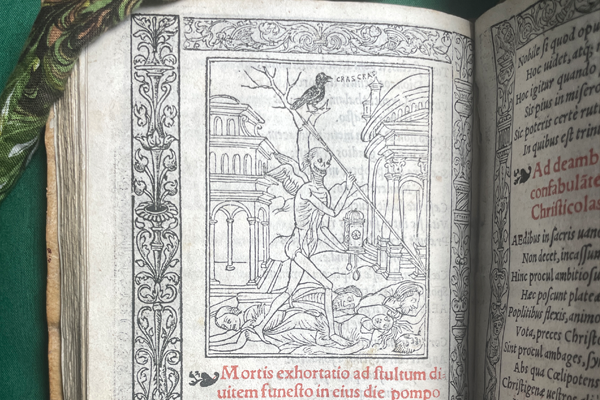
Another 16th-century example comes from a more creative devotional work by Pierre Busseron, Sapphicae Petri Busseroni medicam colentis facultatem, horae, published in Lyon, France, in 1538. It contains neoclassical Latin verse inspired by the prayers and images of a standard book of hours. Above Busseron’s poetry on penance, a woodcut illustration depicts Death as a winged, half-skeletal corpse. Death stalks a city street with victims underfoot, carrying a winged clock (time flies, after all) as a corvid caws, “Cras cras” – in Latin, “Tomorrow, tomorrow.”
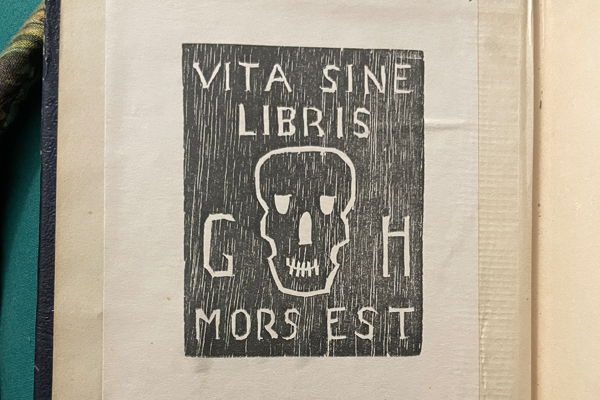
One other haunting memento mori mystery remains not in the rare books, but in the Marian Library’s circulating stacks: A bookplate with a skull, a Latin phrase and the initials G.H. has appeared in several 20th century books requested by library users over the years, including a 1947 missal in five languages. So far, catalog records, accession lists and the books themselves have revealed no information on who G.H. is or was, beyond their library-appropriate motto, vita sine libris mors est: “Life without books is death.”
— Henry Handley is an associate professor and the assistant director of the Marian Library and Special Collections.