In the Marian Library Gallery exhibit Fiat and Faith: Symbolism of the Annunciation, the first image that greets you is an extensive, multicolored wall mural that depicts various symbols in Annunciation artwork, from an apple to a spindle to violets and lilies and the dove that often soars above the scene. One symbol in particular, the beam of light that symbolizes the Holy Spirit or the light of Christ, might catch your eye (as it did mine) with its extended comment: In the medieval period, Mary was believed to have conceived of Jesus per aurem, or “through the ear.”
While many may see this conceptio per aurem idea as a bizarre product of medieval sensibilities, it was central to my research at the Marian Library, where I investigated Mary’s title of “handmaid of the Lord.” My dissertation, which attempts to understand the meaning of this title, incorporates a comparative study of Mary and the Buddhist bodhisattva Kannon (known as Guanyin in Chinese cultures and Avalokiteśvara in the Sanskrit language) in artistic and textual sources. As Kannon is often juxtaposed with Mary due to their analogous compassion and motherhood, I had hoped that researching the bodhisattva could reveal something about the Christian handmaid.
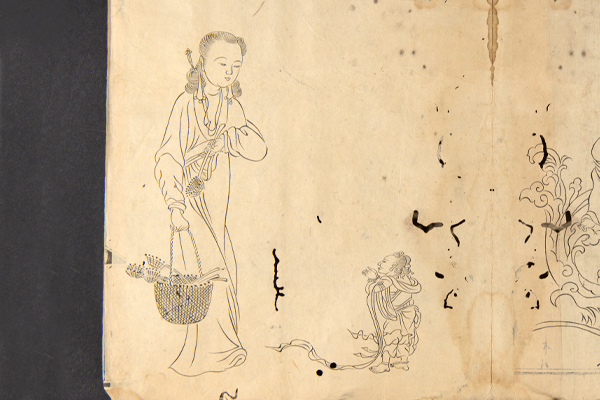
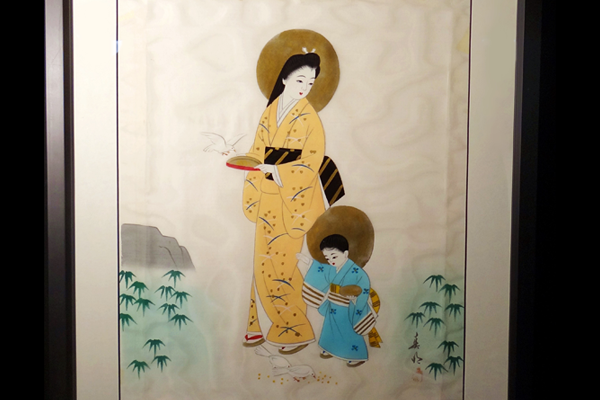
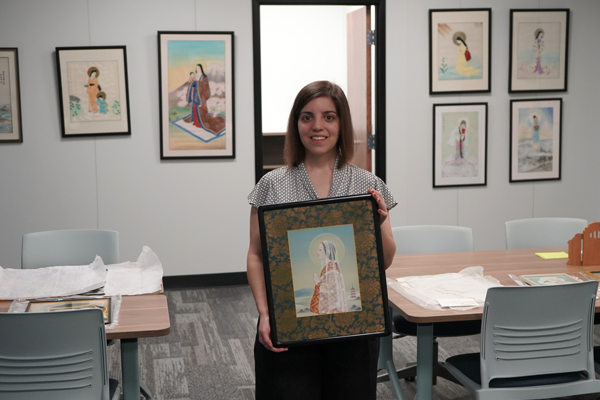
This hope became a reality because of the Marian Graduate Student Fellowship, which offered me the exciting opportunity to study artistic depictions of these figures side by side. In my first week in Dayton, I explored the Marian Library’s extensive assortment of Asian art of Mary — much of which was featured in the 2017 exhibit ‘Ex Oriente Lux’: Marian Art of Asia — in addition to boxes of Marian holy cards, Marian postcards, and the 19th-century collection of Kannon drawings by Japanese artist Tani Bunchō.
As I looked up from Tani’s fluid drawings of Kannon to the Japanese and Chinese Madonnas on the walls of the Special Collections Classroom in Roesch Library, I noticed a commonality beyond compassion and motherhood: Kannon, who often inclines her ear to a believer, and Mary, who inclines her ear to the Christ child, are portrayed as listening. This listening posture is not unknown to Kannon as, after all, her name translates to “one who hears the sounds of the world.” But could the “handmaid of the Lord” also be known for her hearing?
The Annunciation exhibit’s comment on Jesus’s conception through Mary’s ear suggested as much, and in my second week of the fellowship, I turned from the Marian Library’s art collection to its books to seek out more information on this bizarre conception per aurem. Although books on Marian material culture outlined the development of the concept from early homilies into medieval art, wherein the dove was often flying toward Mary’s ear, I encountered a modern adaptation of the concept in the work of theologians like Hans Urs von Balthasar and Cardinal Joseph Ratzinger. For them, Mary is the preeminent hearer, even the pure hearing itself, of God’s word and then consents — “Behold, I am the handmaid of the Lord” (Luke 1:38) — to conceiving this word within her. Not only does Mary’s hearing remain central to her claim of being the Lord’s handmaid, but it is an obedient disposition that all Christians are called to spiritually emulate.
Moreover, as I learned during my fellowship, keeping one’s ears open is also necessary for a researcher because, after all, the answer to a research question might come from an unexpected place.
— Alaina Keller is a doctoral student at Georgetown University in theology and religious studies and the recipient of the 2026 Graduate Student Fellowship.