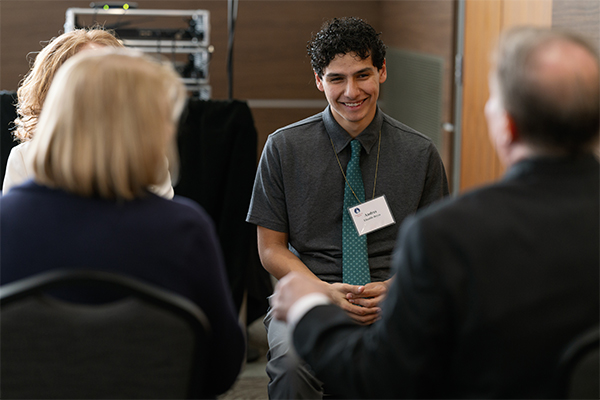
Listening without immediately responding requires patience and presence. It’s also a skill sophomore mechanical engineering major Courtney Boomer practiced with the University’s board of trustees this summer.
Boomer and 20 other students stayed on campus after the spring semester to participate in the board’s formation session to ground themselves in the values and mission of the University, before the board meeting May 12.
The session focused on Catholic education in today’s world through Pope Leo XIV’s apostolic letter “Drawing New Maps of Hope” and used “conversations in the Spirit,” a spiritual practice and communication model for the Catholic Church to give space for connection amidst various perspectives.
“We call it the conversation in the spirit because we truly believe the Holy Spirit is a part of it in some way,” said Noah Novotny, a senior theology major who also participated in the formation.
The trustees and students reviewed highlights from the Pope’s letter before splitting into small groups for conversations.
The students came prepared to lead, having practiced this formation in April, and guided the group through the conversation model’s three phases and structure. They also crafted the questions for the small groups to answer: With Pope Leo’s letter in mind, do your experiences with UD reflect this charism of community and inclusion; what challenges do you face or concerns do you have in this era of higher education; and what gives you hope?
During the first phase, each person had two minutes to answer the initial question. The others were instructed to simply listen and witness — no responding or interrupting. If the person speaking finished before their time was complete, the group sat in silence.
“What’s really jarring is when no one is talking and you have to sit there with that,” Novotny said. “For me it was kind of nice, it was freeing to be able to just listen. I realized when I’m talking to people and they struggle to think of a word, I will interject and try to help them. I noticed myself thinking that but not acting on it, and I was kind of surprised with myself. It was nice to receive and listen to what they were saying and not feel like I had to respond to it. There’s a bit of surrender that’s needed.”
“There’s a bit of surrender that’s needed.”
The second phase allowed each individual to reflect on what was shared during the first phase, again for two minutes each, and the final phase allowed the group to summarize and take notes.
Boomer said the experience helped her consider and gain new perspectives, and described the conversation’s structure as helping her shift from the ‘you’ aspect of what another person is saying to listening to understand them. Novotny shared a similar sentiment, saying the formation helped close the gap between students and board members to become a ‘we.’
“It feels like the world is made for you to sit comfortably with the people you agree with instead of forcing you to talk to people with opposing sides. So sitting there and talking to people who had very different experiences in life was almost mind-blowing,” Boomer said.
What was said in each group remains confidential and sacred. This boundary allows for sincerity, honesty and vulnerability to learn from each other and build stronger connections to each other, the University and their faith.
This is an important component of the conversation as the formation was inspired by a 2024 trip to Rome that helped more than 11 Flyers learn more about the Church and about their relationship to God, vocation and themselves. The trip was made possible by the Lilly Endowment’s Catholic Education Network to Enact and Resource Synodality (CENTERS) grant to strengthen “synodality” in the U.S. Catholic Church, or the way the Church engages in listening, dialogue and decision-making.
“In our world of sound bites and talking at one another, it is a gift to slow down and listen deeply,” said Kelly Adamson, campus ministry senior director. “Our CENTERS grant gives us the opportunity to form students, faculty, staff and all connected with our university in this deep spirit-led listening and communal discernment.
“Imagine a Church in which we listened more deeply to how the Holy Spirit is speaking in and through each of us. Imagine what kind of world we might create if we listened deeply and pondered like Mary.”