This story was written by Jamie Forsythe and originally published in the Fall/Winter 2026 edition of the ALIVE Magazine, published by the Marianists Province of the United States.
Whether it’s helping to recycle plastic waste in Ghana or to make composting more efficient at a food bank in Ohio, student participants with the ETHOS Center step up to the challenge.
Most participants are engineering majors who know how to think through technical challenges and figure out solutions that will work for global and domestic partners of the Center, which is celebrating its 25th anniversary.
The Center is at the University of Dayton (UD), a Catholic research university founded in the Marianist tradition. ETHOS—Engineers in Technical, Humanitarian Opportunities of Service-learning—was the vision of a group of students back in 2001.
“It’s been so heavily supported by students these past 25 years,” said Scott Schneider, director of the center. “They are a critical component to what we do.” He added that several students remain engaged well after graduation with at least one founding student still involved.
“It’s a great way to broaden your perspective as an engineer,” Schneider said of the Center. “And to understand the impact engineering can have on helping solve some really challenging questions and issues.”
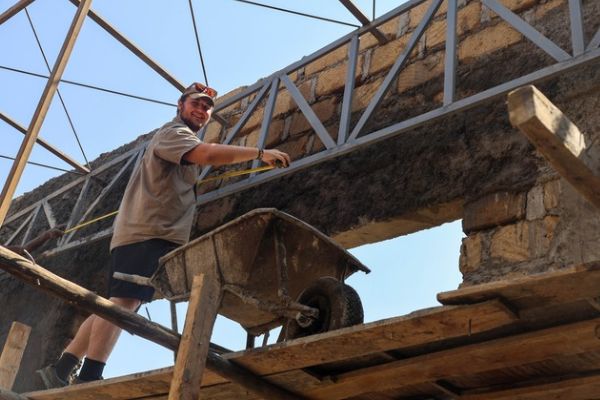
The Center provides opportunities for students to develop social responsibility and interdisciplinary skills through immersion trips, breakout excursions, research and development projects, and a course titled Sociotechnical Engineering for the Common Good.
Schneider said it’s an optional program that students use to enhance their skills while serving others with the assistance of 12 partner organizations.
Senior Caroline Kawiecki, 21, said ETHOS was one of the main draws for attending UD. “Engineering for the common good has been a passion of mine before I knew that phrase,” she said.
In seventh grade, she read a book about African women traveling long distances to collect water in buckets, and the water wasn’t even clean. “Since then, I have wanted to travel to a new place and use technical skills to create solutions in areas that may not have access to resources that I have been blessed with,” Kawiecki said.
UD graduate Peter Fabe described it as “a real blessing” to have the university provide “an opportunity for students to be helpful to projects and communities that don’t necessarily have the capital resources.”
ETHOS is one of the main reasons Fabe attended UD, because students can use their skills to “make the world a better place.”
“Engineering students [have] the opportunity to exercise what we were called for as Catholics: to love and serve others,” Fabe said.
Like Fabe, UD junior Andrew Burdick said, “ETHOS was what really drew me to UD.” He added that his parents are Lay Marianists.
While a majority of the ETHOS participants are engineering majors, Schneider said students with other majors have participated, too. The Center serves roughly 100 students every academic year. They pay a program fee to participate in the travel opportunities.
Breakouts
Sophia Dugan, 23, participated in two breakout sessions, traveling first to Guatemala during spring break in 2024. The group completed a variety of projects over eight days, including tearing out landscaping and transforming a school courtyard so it could be used to grow food, and also installed solar panels at rural homes with no electricity.
Dugan said she was appreciative of the warm welcome she received in Guatemala. “One thing I wasn’t expecting that surprised me was how hospitable everyone was to us,” she said, noting one family brought them a watermelon on a hot day.
She said her experience in Ghana during the 2025-2026 winter break was “really different” than Guatemala as she and her fellow students designed a garden irrigation system near a water filtration system, which required meetings beforehand with their nonprofit partner. She described the project as “more rewarding” since they had “more ownership and more responsibility.”
“It definitely made me realize I want my work to feel meaningful and rewarding,” Dugan said. “I know what it’s like to work on a project that really impacts a lot of people.”
Kawiecki traveled to Ghana with Dugan. In addition to building an irrigation system, Kawiecki said they also held a STEM—Science, Technology, Engineering, and Math—camp for middle schoolers to “understand basic principles of engineering. It was incredible to inspire young women.”
Kawiecki was impressed with the hospitality as well. “We traveled to a nearby village and met families and the chief... We were bombarded with so much love from the kids,” she said.
In 2024, Kawiecki also traveled to Ecuador with The Tandana Foundation to work on a carbon purification system. The group designed the filtration media, performing “analysis to determine the best carbon material including factors of accessibility, cost, and filtration quality,” she said.
Immersions
Immersion programs run six or 12 weeks. The programs allow students to immerse themselves in another culture while completing a community project.
Fabe traveled to India for two immersions. Working with Auroville Centre for Scientific Research in 2019, Fabe and others created a “very large 3D printer” used to construct walls for houses and shared outdoor bathrooms with “material native to the region,” he said.
He explained that they used “technology that brought back an ancient recipe for building to hopefully make housing more sustainable in the long-term for the region.” He returned in 2022 as a graduate student to work as a project manager on site. With three undergraduates, they worked to make the 3D printing machine portable.
Burdick recently spent three months at a Kenya immersion. “We built a community kitchen that will allow for eight people to cook inside it at one time,” he said, noting it’s powered by solar panels. He explained that the dwellings typically have charcoal-burning kitchens. Burdick and his group also installed solar panels at two schools.
UD graduate Molly Savage, 29, worked on improving solar ovens for cooking during an India immersion in 2019. “I learned a lot about the culture and the connectedness of the community there,” she said. “I really experienced people relying on each other in a very beautiful way.”
Takeaways
“I think an ETHOS experience is called an experience because you come away from it changed,” Savage said. “It’s really hard to describe that in words; to have an opportunity where you can grow in such a personal and professional way that also allows you to experience something new about the world and about yourself.” She also said her participation in the ETHOS programs taught her how to look beyond herself to better help others.
Kawiecki said she was able to practice her Spanish in Ecuador. “The connections I made [despite] a communication barrier made them so much more special,” she said.
Fabe said the immersion trips helped shape his “vision and perspective of what an engineer should be,” which he passed on to other students as a UD graduate assistant and PhD candidate at the University of Michigan. “It taught me humility — at a time when I thought I knew everything,” he said.
Schneider said he sees growth in students who participate in ETHOS. “They are learning more about themselves and how they want to work as engineers,” he said.
Burdick said his experience in Kenya helped him “to really grow as a person and not just as an engineer. ‘What can I be doing to help the world; not just my local community here,’ Burdick said. ‘How can we all work for the benefit of each other?’”
Jamie Forsythe is based in Springfield, Missouri.