What gives you hope?
More than a feeling, hope propels us through life and builds resilience when our faith is tested. Members of the University of Dayton family offer their hope-filled moments.
What gives you hope? A precocious student. A medical breakthrough. An Easter miracle. An autumn-fallen leaf followed by a spring-fed bloom.
So many in the Flyer family shared what gives them hope in a time when we need it the most.
Jack Bauer, professor of psychology, said hope is needed because it gives our present actions of everyday life the opportunity to grow and support our larger goals.
In psychology, your degree of hope depends on will and way — your inner drive and your road map to get there.
“Do I think I can do something to make it happen, and is there some kind of plausible pathway to get there?” Bauer asks.
Hope gives the emotional anticipation that a goal will turn out well as we weave and bob through life.
And having hope is essential. Bauer points to studies of rats rewarded with treats for reaching a goal, only to have their path repeatedly thwarted — and they just give up. We may lose hope because we’re too stuck on one pathway to see other avenues, or we may learn to lose hope when life repeatedly kicks us in the teeth.
Optimism is another concept that gets coupled with hope. While hope is the drive and the map, optimism is the mental attitude that outcomes will generally be positive. To say someone is optimistic about world peace says more about their personality than their influence on geopolitics.
Bauer puts a lot of faith in people and in love — and so too does the Flyer family, who mentioned students, relatives and friends in their responses to the question, “What gives you hope?”
Faith is a concept adjacent to hope, Bauer said, and is the basis on which all hope rests. Your view of reality can come from religion or science or the natural world — what matters, he said, is that you deepen that faith by questioning and challenging it.
An epistle from James in the Bible tells us to be joyful when we experience trials, for the testing of faith produces endurance.
It is in the questioning that we see faith embedded in stories about a world of actions with other people. Bauer points to a “mystical sense of connectedness.” When we first learn to smile, we are reacting to the caregiving offered by a parent. When we “lose our faith,” it can be restored by the kindness of a neighbor or the intervention of a stranger.
Mary, the mother of Jesus, had her faith tested often — from Jesus’ birth to his death on the cross — yet lived in the abundance and possibilities of hope. Neomi De Anda, religious studies professor and executive director of the International Marian Research Institute, calls this empapamiento — Spanish for a soaking or drenching.
“Mary lives an empapamiento of hope, extremely saturated to the point that the hope continues in the midst of pain and suffering because she knows that she creates paths with others in this difficult journey,” she wrote.
A faith-filled hope is celebrated with others. “[We] must be able to depend on communal hope when ours grows weary,” she said.
If hope is indeed a journey, its abundance can be viewed in the progress of the tiniest seed. Sandra Yocum, who served as University Professor of Faith and Culture, used this metaphor during her talk at a Marianist Founders celebration in January.
“Hope is not dependent on what I might be feeling,” she said. “Like every other seed that I plant, seeds of hope are not of my making.” They are gifts given to us to plant, she said, and that action begins and ends in God, the source of all that exists.
In addition to spiritual and existential reasons for hope, Bauer adds this practical note: “There is always a perspective that one has not considered.” His advice is to shake up your point of view. “Maybe take a walk and clear your mind. Then ask, ‘What aren’t I seeing?’”
So, dear reader: What gives you hope? Email magazine@udayton.edu. We hope you will — because sometimes a new perspective begins with simply hearing how someone else finds their way.

Olivia Garrison / Political science and economics sophomore
Reno, Nevada
“What gives me hope is that there are people who are still engaged. People still post stupid memes on the internet when we’re all just baffled by the concurrent events of general democratic decline, the explosive diarrhea parasite and the wildfire smoke hitting the Midwest in the same week. My friends still do listen when I talk to them about things that are happening, or when I encourage them to register to vote.”
 Angie French Dunn ’87 / Adjunct professor
“Teaching my UD students how reading works and how to teach reading effectively — knowing they leave my course understanding research-based instructional practices gives me a lot of hope! As they move into student teaching and their own classrooms, they have the opportunity to change so many children’s lives simply by teaching them to read. Literacy and justice for all!”
Hope in the quieter parts of life
 Art Jipson / Associate professor of sociology
Hope does not come to me as easily as it once did. Like many people, I spend much of my time reading difficult things, studying social problems and trying to understand why people sometimes choose cruelty over compassion. My work asks me to pay attention to extremism, division, misinformation and violence. After a while, it can become easy to believe that these forces define our world.
But they don’t. I find hope in the quieter parts of life that rarely make headlines.
I find it in a classroom when a student suddenly sees a connection between sociology and their own life. There is a particular look that comes over someone when they realize the world is not simply the way it is because they have been told it has to be that way. Students begin to imagine it could be different. Those moments remind me why I have spent so many years teaching. Education is, at its heart, an act of hope. Every semester begins with the belief that people can learn, grow and become more thoughtful than they were yesterday.
I find hope in music. A great song can carry memories, tell difficult truths or simply make an ordinary Tuesday afternoon feel a little brighter. Local musicians especially remind me that creativity does not depend on fame. People continue to write songs, start bands and perform in neighborhood venues simply because they believe art matters. That quiet persistence is its own kind of optimism.
I find hope in gardens. Every spring asks us to trust that what looks dormant is only resting. Seeds disappear beneath the soil long before they become flowers or vegetables. Gardening teaches patience in a culture that expects instant results. It reminds me that growth often happens where we cannot yet see it.
I also find hope in small acts of kindness that are easy to overlook. A stranger holds a door. Someone checks on a friend. A neighbor shares tomatoes from the garden. Students encourage one another before an exam. These moments rarely appear in our social media feeds because outrage is more profitable than generosity. Yet I suspect these ordinary acts of care happen far more often than we realize. They quietly hold communities together.
Perhaps most surprisingly, I find hope in people who refuse to give up on one another. History is full of moments when it seemed that fear or hatred would have the final word. Again and again, ordinary people chose something else. They organized, cared for neighbors, challenged injustice and built institutions that reflected their highest ideals rather than their deepest fears. Progress has never been inevitable, but neither has despair.
Hope, then, is not wishful thinking. It is a practice. It is choosing to plant the garden, teach the class, support local artists, volunteer in the community or simply listen carefully to another person. Hope grows through participation.
 Gov. Bob Taft / Distinguished research associate
“I find hope for the future from so many current UD students, a good number of whom are involved as summer interns in Ohio government in UD’s Statehouse Civic Scholars program or in Washington, D.C., via the DC Flyers program. These students have strong intellects, an interest in public service and a capacity to work well with others in accomplishing their goals. Many who have graduated are already leaders for the next generation performing significant roles in our local, state and national governments.”
Imagine beyond AI
Ngọc Nguyen / Assistant professor, Department of Computer Science
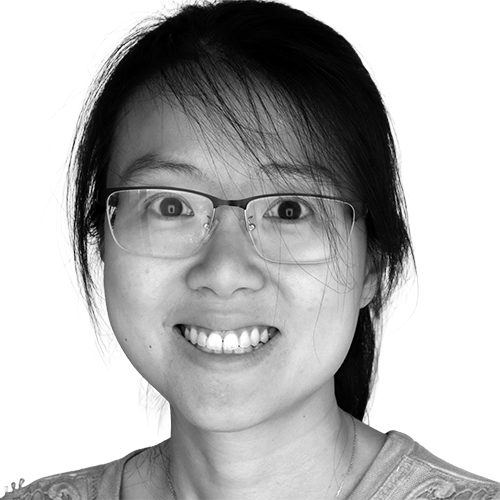 I imagine people assume that working in AI gives me hope because of what the technology can do. In fact, what gives me hope is what I have learned about people.
A good part of my research work is about understanding how people learn, adapt and make decisions under uncertainty, often in collaboration with intelligent systems. Over the years, one thing has stayed with me: People rarely make perfect decisions, and yet they keep learning. They revise their beliefs, adapt their strategies and somehow find a way forward. That ability to learn and adapt, more than AI itself, gives me hope.
Perhaps that’s why I have never seen AI as a replacement for human intelligence but as a way to better understand and complement it. To me, its greatest potential is helping us think more clearly, learn more effectively, work more efficiently and ultimately make better decisions.
I find hope in my students, too. More and more, they are not asking only what AI can do, but what it should do. Their questions about trust, fairness and explainability remind me that the future of AI will be shaped not by technology alone but by the people who build and use it.
 Connor Heck / Third-year law student
Tipp City, Ohio
“In all of the people we work with through the Ohio Governor’s Expedited Pardon Project, you can feel their hope. As law students, we serve as a kind of liaison: We sit beside them, support them, hear their stories as they navigate the pardon application process. I do this work because I see hope in the opportunity for a second chance. Not everybody gets the same life experience, so I think it’s important to give them a chance for a different life outcome.”
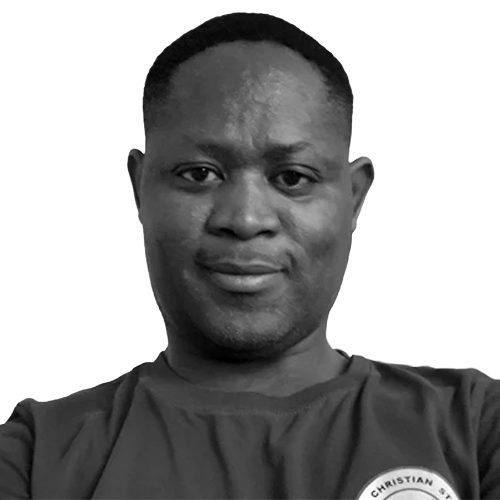 Brother Dancun Onyango, S.M. / Biology master’s student
Kisumu Archdiocese, Kenya
“My hope in life is that I will be more meaningful in my career as a Marianist. I was principal and a teacher of biology in a secondary school in Malawi for five years. Coming in December to study for my master’s at UD gives me hope — that the strong faculty will share with us their knowledge so that I will become an expert in my area, and I will go back to strengthen the department of biology at our new school, Our Lady of Nazareth Chaminade Marianist Secondary School in Nairobi, Kenya. Through my education here, I have come to learn that my students need to be included in more hands-on activities. In that way, the subject becomes meaningful and my students see how biology should help solve problems of this earth.”
 Madison R. Dietrichs / Management information systems and accounting junior
Mason, Ohio
“So often, I find myself looking forward to the next event on campus or seeing my family during a holiday break, but turning that hope toward the Holy Sacrifice of the Mass helps me to focus on why I am here at UD in the first place and what type of woman I am becoming.”
Art, science, hope
 Cecilia Martyna / Biochemistry senior
Dublin, Ohio
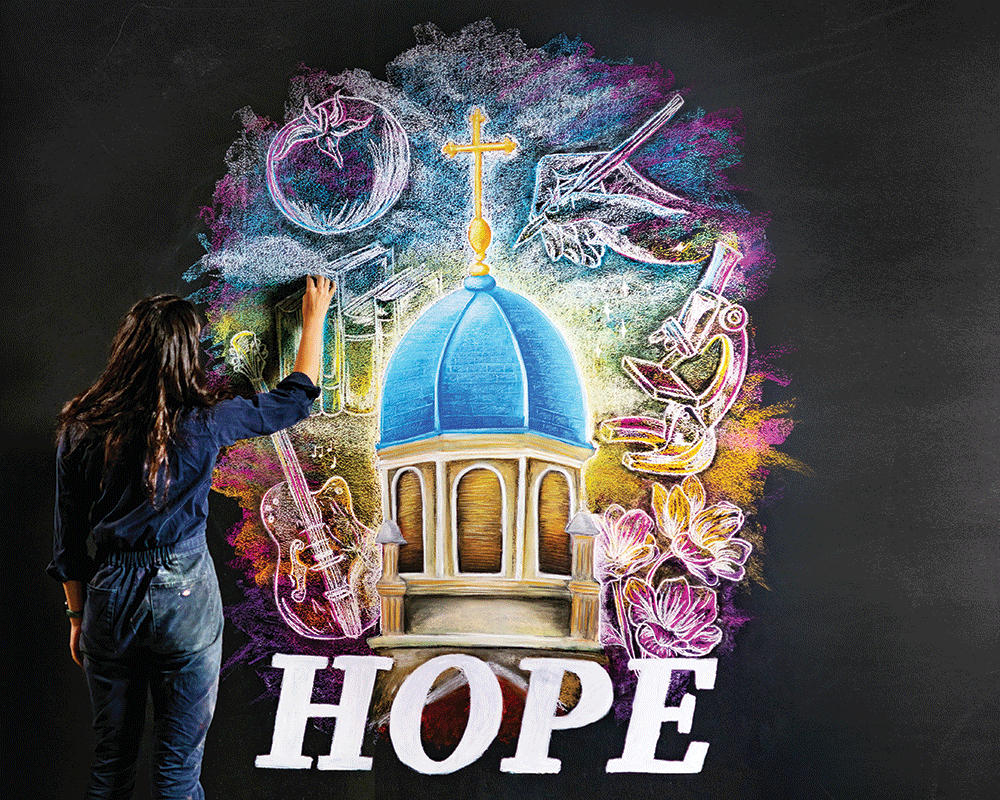
My first research project at UD was on indigo dye. Unlike other plants that are simply crushed to form dye, you have to really dry it, crush it, and then ferment it with ash and lye in large vats before you get that really blue color. Historically, indigo has been used for its antimicrobial properties, so I researched the microbiology to determine if this was true. I also created chalk pastels using natural indigo dye, which is right up my alley as a chalk artist.
I think the really amazing part of the project was that biology professor Dr. Yvonne Sun was so open to exploring something combining art and science that I would be interested in; both art and science bring me hope.
I had chosen a topic for my honors thesis, but in January my father was diagnosed with multiple myeloma, which is a blood cancer. Dr. Sun agreed to let me change course — to study multiple myeloma and the gut microbiome, how conditions in the gut could influence a patient’s treatment and health outcomes. I worked on the literature review over the summer, and the plan is to grow and test intestinal epithelial cells in the lab this fall.
My dad’s doing well now, fully in remission. He returned home from his stem cell transplant after having spent three weeks in the hospital this summer.
As a biochemistry major planning to pursue medicine, I have spent a lot of time learning about medical specialty areas, including pediatric plastic and reconstructive surgery. I saw in the operating room how they would mark out the lip for a child with a cleft, and to me, it immediately looked like how I would mark out my large-scale sidewalk drawings. But when I started spending more time in the hospital with my dad, I also started considering hematology oncology. During his stay, I shadowed his doctor, which let me visit with other patients and see how their stories were parallel to my dad’s. It was a different way of connecting than I had ever had in any other shadowing experience.
I have put in a significant amount of time, taken a hard major and done the things that I need to do to be able to give back to my patients as much as possible. I find that very hopeful.