No sweat
UD Sinclair Academy celebrates 10 years with 250-plus graduates and a support model that eases the opportunity for success.
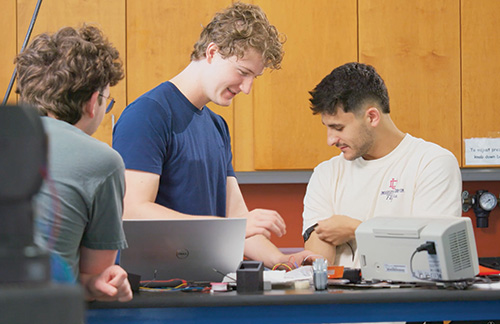
Senior Owen Fors spent spring semester in Kettering Labs testing a material made of carbon nanotubes to measure muscle strain. He wrapped the black armband around his bicep and flexed, while classmates in his capstone course collected real-time workout data.
But the mechanical engineering major said it was no sweat transitioning from the local Sinclair Community College to finish his degree at UD.
“When you first start at Sinclair, they have a whole pathway set out for you,” he said.
“When you first start at Sinclair, they have a whole pathway set out for you.”
Fors is among hundreds of students who, in the first 10 years of the UD Sinclair Academy, have enrolled in this pathway that removes financial barriers by allowing students to start at Sinclair and transition to UD to earn a bachelor’s degree — with access to UD life and support from day one. More than 250 students have already earned a UD degree, with 100% employed, in advanced study or in service six months after graduation.
“You meet a lot of really great people through each process, of being at Sinclair and being at Dayton,” said Fors, who graduates in December. “They care a lot about what you’re wanting to do and how your education is going.”
This includes advisors and peer mentors, who have also been key to the success of two other UD programs that help make a UD degree accessible, Kessler Scholars and Flyer Promise Scholars. Because of that, every UD undergraduate now receives a holistic advisor and Flight Crew that guide and support them during their academic and personal journeys at UD.
While the armband is still in the prototype phase, Fors said the project — and his time at UD — have allowed him a glimpse into his future.
“It's been very eye-opening to have a goal, have deadlines, work with a company partner and give them, at the end of the day, a product that they were wanting us to make,” he said.
Photograph by Brigham Fisher.
A version of this article appears in print in the Autumn 2026 University of Dayton Magazine, Page 24. EXPLORE THE ISSUE — MORE ONLINE