Building blueprints for future health leaders
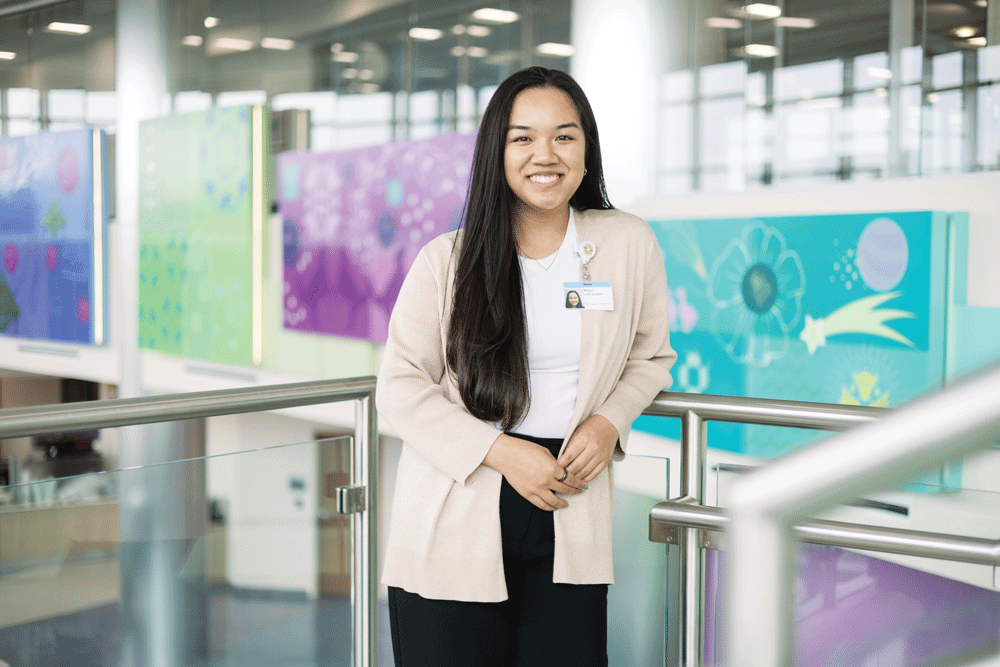
When the University of Dayton launched the Health Engagement Fellows Program in 2023 through the Fitz Center for Leadership in Community, the inaugural cohort was challenged to see health not only as future clinicians, but as advocates, researchers and community partners.
Open to first‑year and UD Sinclair Academy students from any major, the three‑year program begins sophomore year and prepares students for careers across the health landscape — from public health and policy to direct patient care. Through a connected curriculum and two years of paid internships, fellows take on community projects, capstone work and research experiences.
Now as they step into their post‑UD paths, graduates say the program continues to shape how they understand healthcare, community and their places in both.
What happens when students learn to see health beyond the clinic?
Alexia Benton ’26, a premedicine graduate with her sights set on neonatology, said the Health Engagement Fellows broadened her understanding of what it means to care for patients.
“I was immediately interested because I was already drawn to medicine,” she said. “But the program was more focused on the bigger picture; I wanted to better understand the systemic issues and inequities in access.”
She spent two years interning at Daybreak, a youth homelessness organization in Dayton, greeting clients, leading budgeting and self‑care groups, and building trust with young people who were often her peers.
“We were around the same age as a lot of the clients, so they didn’t really know how to interact with us at first,” she said. “But after a while, they understood we were there for them. We were bridging the gap between staff and clients.”
The experience helped her see how social determinants of health — like housing, transportation, income — shape outcomes long before someone enters a clinic.
“Medicine is not just about diagnosing or treating a condition,” she said. “It’s about understanding the patient’s background, their environment and the barriers that may affect their ability to receive care.”
Classroom discussions reinforced that lesson.
“Learning about insurance systems was really eye-opening,” Benton said. “I didn’t understand the specifics, and it showed me how complicated navigating [care] can be.”
In her gap years before applying to medical school, Benton is retaking courses, preparing to start a medical scribe job and traveling — including hopes to visit Japan and the Dominican Republic, where she has family. She said the program influenced the kind of doctor she hopes to become.
“It changed my perspective on healthcare,” she said. “I feel like I’ll be a better, more compassionate doctor.”
“Medicine is not just about diagnosing or treating a condition. It’s about understanding the patient’s background, their environment and the barriers that may affect their ability to receive care.”
How does empathy become a professional skill?
For Megan Nguyen ’26, the path after graduation began with a dermatology clinic in northeast Ohio. She applied for medical assistant positions to gain clinical experience during her gap years. When a dermatology office offered her a job, she immediately felt at home.
“I was shadowing one of the medical assistants and everyone was just running around and working together,” she said. “I felt like this is really the place for me.”
Her training was intensive: a six‑week manual, learning the clinic’s electronic medical record system and memorizing protocols for the skin conditions the office treats. She now floats between locations, sets up exam rooms, assists providers and scribes every detail of patient visits.
But the lessons she carries from UD are not only technical.
“The [program’s] internships gave me a lot of empathy for patients,” she said. “Now when someone is late or struggling, my mind doesn’t go straight to, ‘Oh, they were just being thoughtless.’ I’m thinking something might have happened, and I try to make sure everything’s really OK.”
Her senior‑year internship at Five Rivers Health Centers in Dayton also taught her how systems shape care. She and another fellow conducted research on immunization hesitancy and cervical cancer screening among unhoused women.
“The [program’s] internships gave me a lot of empathy for patients. Now when someone is late or struggling, my mind doesn’t go straight to, ‘Oh, they were just being thoughtless.’ I’m thinking something might have happened, and I try to make sure everything’s really OK.”
She also volunteered at a screening event at St. Vincent de Paul shelter and later managed a large‑scale social needs assessment project for CareSource, a nonprofit managed‑care organization that provides Medicaid and marketplace coverage in Ohio.
“I probably looked through at least a thousand of these forms,” she said. “It taught me a lot about starting a whole project from scratch.”
The program’s capstone — a yearlong partnership with the Dayton Doula Project, a maternal health and doula training initiative launched through UD’s Health Activation Think Tank — was the moment Nguyen realized the cohort was building something lasting.
“Everyone was really amazed with what we did,” she said. “It felt like a great way to end my time here, kind of the legacy we’re leaving.”
As she works and studies for the MCAT, Nguyen is grateful for the program’s impact.
“I’m OK with feeling like I don’t have everything figured out,” she said. “I’m still learning every day.”
What does it mean to be the first?
Both Benton and Nguyen said being part of the inaugural Health Engagement Fellows cohort came with uncertainty — and also a great sense of pride.
“There was a lot on our shoulders,” Benton said. “That pushed us to work harder.”
Their work helped secure funding for future cohorts, shaped internship partnerships and set expectations for what the program could become in the next decade. As the program grows — now recognized nationally and internationally — the first cohort’s imprint remains clear.
“I’m just really grateful for all the experiences I’ve had up until now,” Nguyen said. “And I know they’ll continue to shape me as I move forward.”
Photography by Sylvia Stahl '18.
A version of this article appears in print in the Autumn 2026 University of Dayton Magazine, Page 50. EXPLORE THE ISSUE — MORE ONLINE