Back to Bordeaux
University of Dayton students hear the word “Marianist” a lot: what it means, why it matters and how it shapes the Flyer experience. But this summer, a group of students saw UD’s Marianist identity from a new perspective in Bordeaux, France, where Father William Joseph Chaminade began the Marianist tradition in 1817.
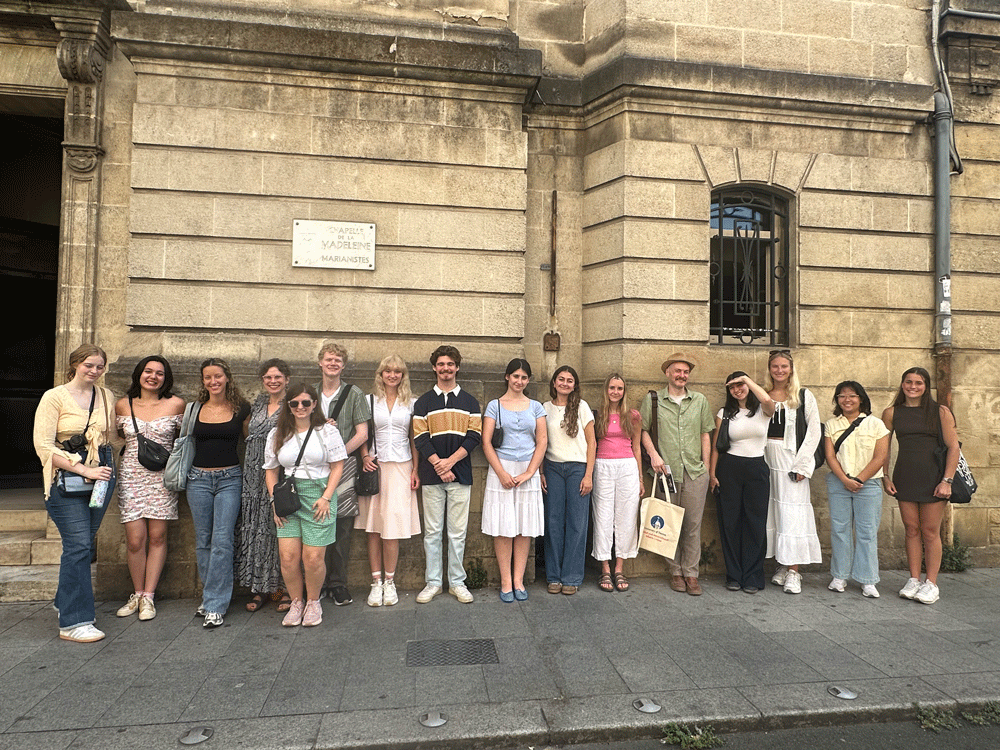
As part of an summer education abroad trip to Paris, associate professor of English David Fine and associate professor Jamie Small, who also serves as the Roesch Chair in the Social Sciences, led students on a two-day side trip to Bordeaux — just a three-hour train ride from Paris — to visit the Society of Mary community.
Marianist brothers welcomed the group into their home, providing a personal tour of their common meeting room, relics space and the Chapel of the Madeleine, which Chaminade made his home beginning in 1804.
“These people aren’t mythical stories but real flesh-and-bone folk who’ve gone about their entire lives and are now living examples of the Marianist lifestyle,” sophomore Corrigan Huner said.
“There’s definitely a difference between knowing your education is rooted in Marianist tradition, and then actually witnessing that tradition in person.”
Huner, a chemical engineering major, grew up Catholic. He said as he got older, he struggled to find where he belonged in his faith. But his experience in Bordeaux renewed his motivation to define religion for himself.
“I think the trip served as an important lesson in adaptability to the change of your own personal faith question and to embrace these changes as becoming a more multifaceted individual,” Huner said.
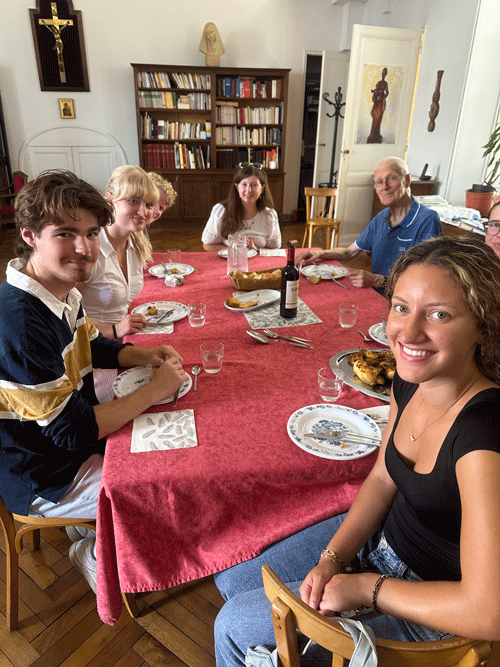
Students saw how the brothers lived, how they prepared meals and shared their faith together. The brothers each shared the story of their own faith journey, life experience and struggles.
“Each of the brothers had a unique life story and were at various stages of their lives,” Huner said. “They had each handled the faith question at a separate time and in vastly different scenarios, and yet had each managed to reach a common ground.”
Small and Fine focused the academics of the education abroad experience on the French Revolution, where students were able to view religion differently from the American context. Through guest lecturers and interfaith site visits — including the Grand Mosque in Paris, which was built in the 1920s, and Notre Dame Cathedral, which underwent significant changes during the Revolution — they learned how the Marianists were founded and how they sought refuge in one another.
The program introduced students to different religions and practices, Small said. In a country where the state strictly separates itself from public religion, France’s history of secularism provided a new perspective on the Marianists and the pressures they faced.
Through their studies, students gained further understanding of the connection between the events in France and the founding of the University of Dayton in 1850. They said they began to think about the importance of the educational foundation that each undergraduate student receives.
Through the daily life of the Marianists and the structure of their community, Small said she was able to see the threads of Marianist identity that permeate UD’s campus.
“I hadn’t had much connection with Marianist brothers, and I certainly hadn’t seen a community like that in person,” Small said. “So to see how they worked — their humanitarian work, their charity work — and how global they were in scope was … an incredible experience.”
Hearing about the Marianist tradition is one thing. But seeing it for yourself where it all began is transformative, Huner said.
“There’s definitely a difference between knowing your education is rooted in Marianist tradition and then actually witnessing that tradition in person,” he said. “It didn’t feel like we were larping (live action role-playing) Marianist action anymore but getting to actively participate in it.”
Photography provided by Jamie Small