We declare: America at 250
“We hold these truths to be self-evident, that all men are created equal, that they are endowed by their Creator with certain unalienable Rights, that among these are Life, Liberty and the pursuit of Happiness.”
Perhaps the most famous line of the Declaration of Independence, these words birthed a nation. As country and campus celebrate 250 years of independence, we look at how religion, song, identity and aspiration were integral in the founding — and how they still march us forward today.
American colonial Catholics: The land they found — and founded
→ Religious freedom was the rallying cry for the colonies, but Catholics soon found liberty was relative to who held power. Students in courses this spring — leading up to the 250th anniversary of the Declaration of Independence — literally stepped into history to learn the stories of the American Revolution and how Catholics played a role in the founding of the nation.

The land of the free” — as America would be hailed in Francis Scott Key’s famous poem — was first colonized by people with a passionate commitment to faith who were seeking freedom from persecution and restriction: Puritans and Quakers from Europe; Jews from Brazil; Mennonites and Dutch Quakers from Germany.
Among them were Catholics fleeing anti-papist violence by the citizens of Britain. Approximately 200 people — some of whom were Catholic, including two priests — disembarked in 1634 from ships named Ark and Dove, landing on territory granted by the Charter of Maryland. It became the first major Catholic settlement in the colonies.
In his courses on early American history and the history of religions in the United States, associate professor Michael Carter teaches his students about what Catholics found when they arrived — and how Catholics contributed to the founding of the United States of America.
Freedom, it turned out, was relative to who held power.
Cecil Calvert, the second Lord Baltimore and a Catholic, founded the Maryland colony hoping it would offer religious liberty to English Catholics. But when Puritans took control of the colonial government in the 1650s, they imposed legal restrictions on Catholic practice. Even so, the Catholic population continued to grow.
One of those Maryland Catholics was Charles Carroll of Carrollton, regarded as the wealthiest man in the American colonies in 1775. He was the only Catholic signer of the Declaration of Independence and used his personal wealth to fund the Revolutionary War.
Carter received a private tour of the Carroll historic home near Baltimore, including the family chapel where priests said Mass despite a ban. Carter saw the table where Carroll shared dinner with George Washington, and he walked the hallways of the home where founding fathers Thomas Jefferson, John Adams and Benjamin Franklin stayed as guests.
Carter brings that same sense of lived history to his teaching. This spring, his students toured a Revolutionary War site in Ohio Country located in present-day Springfield just outside of Dayton. There, Carter brought to life the Battle of Piqua between combined British-Native American forces and the revolutionary militia of Col. George Rogers Clark. He pointed to the ridges, hills and river, connecting the battle’s development to the natural landscape.
When you can’t tour or touch history, the next best thing is to access the digitized originals.
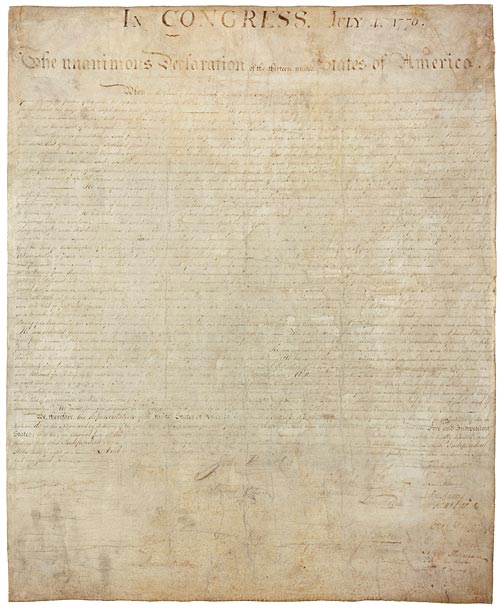
“Here it is unfolding before your eyes,” Carter said, showing students the Declaration of Independence and its rough drafts, available online. In all of his lessons, he challenges students to understand the time and place in which history was made. “What does the founding mean to different people at different times, and how has that shifted?”
“What does the founding mean to different people at different times, and how has that shifted?”
Junior Kevin Krebs signed up for American History Through 1865 specifically because of the Declaration’s 250th anniversary. “What better use of time than this?” said the accounting major, whose spring course load included five other classes, including four in the business school.
Krebs was struck that Carroll signed the Declaration at a time when Catholics made up around 1% of the colonial population and when laws often enforced the dominant faith’s cultural and religious norms.
“Everything was surrounded by their God,” he said.
“It’s hard to think that something like going to church, that I do every Sunday, was dangerous to do,” said Krebs, a Catholic who attended Jesuit grade school and high school.
In class, students reviewed the two most popular broadsides of the Declaration, printed in 1776 and 1777. They learned that natural law, a moral framework derived from reason and nature with roots in the intellectual writings of Jesuit St. Robert Bellarmine, influenced Jefferson’s penned arguments for independence. Students also learned that “freedom” from British tyranny was not the universal “freedom” we embrace today; for example, Carroll was on record questioning the morality of slavery but was the largest slaveholder in the colonies at the time of the Revolution.
Other Catholics appear throughout early American history, including John Barry, captain in the Continental Navy, and Elizabeth Ann Seton, a child of the Revolution who became the first U.S.-born saint.
Charles Carroll’s cousin, Jesuit Father John Carroll, became the first superior of missions for the United States in 1783 — an order by the Vatican that freed American Catholics from the British Catholic Church’s control. John Carroll became the first bishop of the first U.S. diocese, in Baltimore, at a time when just more than two dozen Catholic priests lived in colonial America. He and other clergy consecrated the diocese to Mary, which led to the 1846 adoption of Mary, as the Immaculate Conception, as the patroness of the United States.
That religion played such a role in the founding of a country now known for the phrase “separation of church and state” surprised Krebs at first — until he read in class a study that showed St. Paul is the most often quoted source in America’s founding documents. Turns out, his spring semester course on the writings of St. Paul proved to be a perfect resource in his reflection on the nation’s anniversary.
4 myths about the Declaration
Misconceptions about the Declaration of Independence are debunked in associate professor Michael Carter’s courses — American History to 1865 and History of Religion in the United States. Students interact with digital versions of the original sources and learn about the time, context and people who created our nation’s most famous founding document.

1. MYTH: Colonists first learned of the Declaration of Independence in their newspapers.
TRUTH: The Continental Congress printed 200 copies and distributed them on July 5 to every colony to be read aloud in public. It was first published in the Pennsylvania Evening Post July 6.
2. MYTH: All signatories were on the July 4 printed document.
TRUTH: Only the names of John Hancock, president of the Continental Congress, and Charles Thomson, secretary, were on the first copies. In the months after July 4, the signatories added their own “John Hancocks” to the final, engrossed parchment.
3. MYTH: Hancock signed his name big so King George III could see it without glasses.
TRUTH: Hancock’s signature was always large, and George III had just turned 38 in June 1776. Plus, the Continental Congress never intended to send the document to Britain.
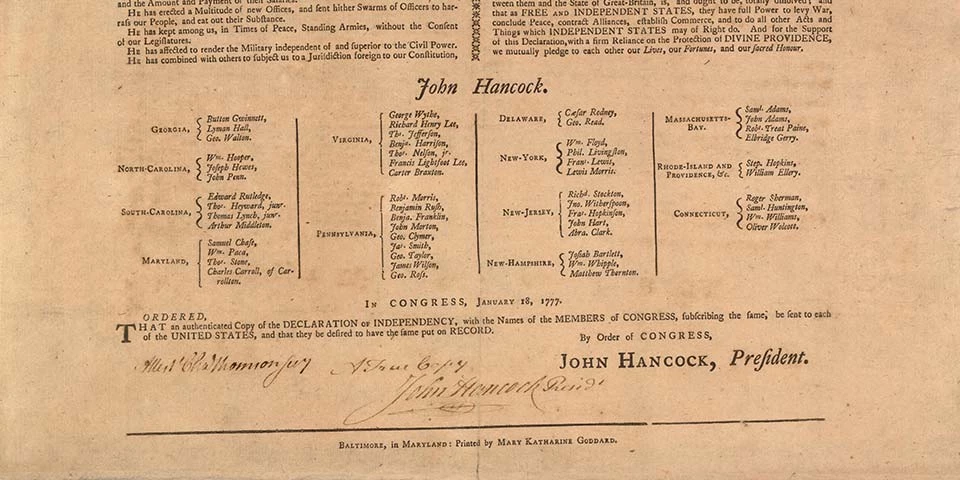
4. MYTH: Only men are named on the printed Declaration.
TRUTH: Mary Katharine Goddard was the second printer of a broadside of the Declaration (shown above), in January 1777, and the first to include the typeset names of all signatories. She added her name as printer at the bottom despite the threat of imprisonment for treason.
A version of this article appears in print in the Summer 2026 University of Dayton Magazine, Page 21 and Page 23. EXPLORE THE ISSUE — MORE ONLINE