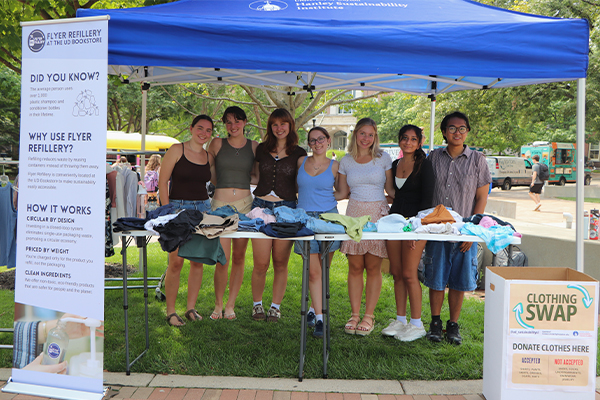
Three times a semester, students across campus swap clothes for free. As a member of the Circularity Team in the Sustainability Student Leaders program, I help make that happen, and it has taught me just what it takes to implement circularity into daily practices.
Circularity is an economic model in which resources are used over and over again, rather than the pattern of extract, consume and dispose that most of us are used to. The fashion industry is a huge contributor to throwaway culture, which is prevalent on our campus.
College students are short on time and money, and ultra-fast fashion brands, such as SHEIN or H&M, make it easy for students to get cheap clothing that they can wear for a season to follow the latest trends and then dispose of afterward. It’s easy to see the appeal, but there are so many options that are better for the planet and are often cheaper.
According to the UN Environment Programme, the fashion industry accounts for approximately 2-8% of global greenhouse gas emissions and annually uses the equivalent of 86 million Olympic-sized swimming pools.
A landmark study by the Ellen MacArthur Foundation found that total greenhouse gas emissions from textile production are higher than those of all international flights and maritime shipping combined. These facts show a clear need for a circular economy, especially in the fashion and textile industry.
What struck me most in my research is that it’s more than just how much we buy, but how the clothes are made. Synthetic fibers like polyester are generally more carbon-intensive to produce than cotton, and washing them releases microplastics into waterways, furthering environmental harm.
I find it frustrating to watch my peers continue to order through fast fashion brands, so how can we as students reduce the negative impact the fashion industry has on the environment? One answer is our Clothing Swap program, which keeps clothes in use from students, for students.
Throughout each semester, the Circularity Team collects and sorts donated clothes from across campus. During an event, clothes are weighed and counted as students choose the items they want to keep, free of charge.
Since starting this initiative in fall 2024, nearly 500 students have participated, swapping and donating nearly 1,000 pounds of clothing. Surplus items are donated to St. Vincent De Paul to continue supporting our Dayton community.
Reusing and swapping are central to our Circularity Team’s mission of developing and supporting programs that promote and implement circular practices on campus while encouraging students to incorporate sustainability into their everyday lives.
At any point in the semester, students or staff can donate clothes they no longer need to any of the following donation bin locations: Roesch Library (first-floor staircase); Marycrest Hall lobby; Stuart Hall lobby; Marianist Hall lobby; Virginia W. Kettering Hall lobby; Campus South lobby; Science Center lobby; The Brook Center; Fitz Hall room 585; or the Fitz Center for Leadership in Community second floor.