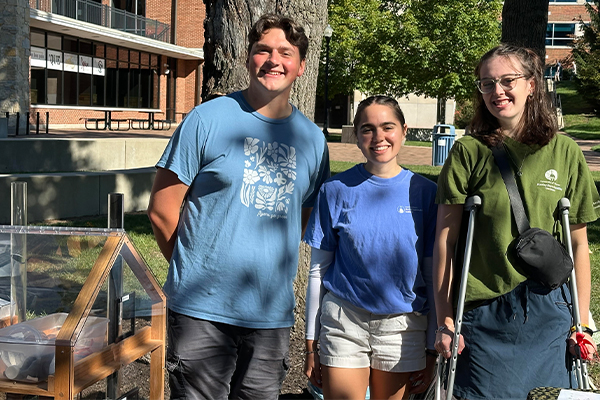
As a civil engineering major at the University of Dayton, I have a passion for the built environment. During my first year as an engineering student, I really enjoyed my curriculum, but I felt like I was missing part of my passion for the environment. That is why, in my second semester, I decided to add a minor in sustainability and simultaneously began to work with the Sustainability Student Leaders program.
As I have become integrated into the program, I have been able to promote, run and plan numerous activities to engage students in sustainability on campus. One of my favorite parts has been applying the problem-solving skills I have learned in the classroom to help brainstorm new projects or revamp current ones.
Within the Sustainability Student Leaders program, I am a member of the Residential Energy Team, highlighting my passion for the intersection of energy and sustainability. I quickly realized that UD’s student neighborhood provides a unique opportunity to promote sustainable living, given that students live so closely in an abundance of on-campus houses. Our team focuses on improving residential energy efficiency in the student neighborhood and educating students on energy use in their homes.
To do this, we host Energy Assessment Bootcamps to teach students about residential energy from a technical standpoint, educating residents on how the built environment impacts the energy efficiency of a house, not just individual actions. In addition to bootcamp, we also recently launched the Sustainable Flyers Residential Energy program, an at-home walkthrough program that teaches students how to live sustainably in their daily actions by meeting with them where they are — in the home they live in.
An important aspect of our work is hands-on learning. Our team uses a modeling tool called the House of Pressure to visually demonstrate to students how hot and cold air move through their home, mimicking an HVAC system and the efficiency of a home. This semester, we enjoyed bringing this demonstration to a wider audience at the Family Weekend farmers market, interacting with families, parents, alumni, students and more.
This was definitely the most impactful event I have contributed to on campus, as we usually only interact with students. Our demonstrations with the House of Pressure provoked interesting conversations with parents who had a real-life experience with energy efficiency or sustainability. This event gave us the opportunity to engage in open dialogue rather than a typical bootcamp-styled education session, making the whole experience more beneficial for myself and other participants.
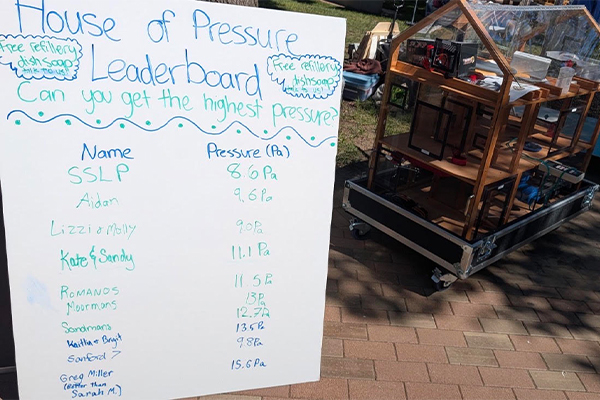 To spark friendly competition, we implemented a leaderboard for families to try to achieve the highest PSI. The higher the PSI (the measure of pressure), the less air can move in or out of the house, making it airtight. An airtight house is more efficient to heat and cool, as there are no leaks. While a livable house is not a vacuum, so a balance in airflow and airtightness must be found, it is important to understand how to prevent leaks as a first step to household efficiency.
I found many of the people who were interested in our efforts also connected sustainability to their jobs. I had meaningful conversations with engineers about how they are incorporating sustainability into their professional projects. I also got to learn about how other industries also prioritize residential sustainability, even if it isn’t for environmental reasons. For example, I had a conversation with a professional in the trade industry who is constantly working in people’s homes and tries to educate homeowners on proper home care and efficiency to save money, showing that residential energy efficiency has benefits beyond environmental sustainability.
As a civil engineering student, I really enjoyed these conversations, and they provided me with hope of finding a job that allows me to incorporate sustainability into engineering. As I continue my academic journey and professional experience with the Sustainability Student Leaders program, I hope to take all that I have learned about engagement and apply it in future sustainability projects.