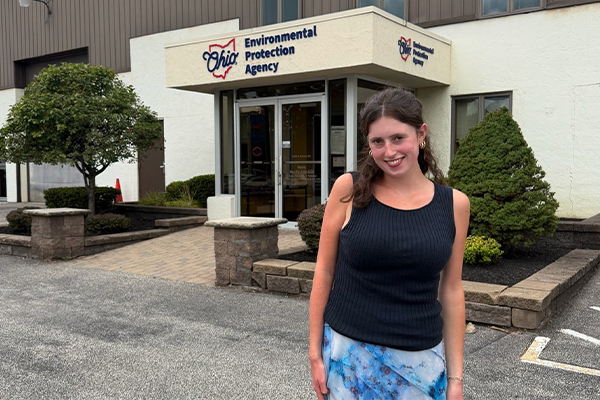
This summer I had the privilege of interning with the Northeast Ohio Environmental Protection Agency as a library and information science college intern. As a sustainability major and member of the Food Systems team with the Sustainability Student Leaders program at the University of Dayton, my academic and professional values aligned greatly with this work.
My role on campus as a student leader has given me hands-on experience that prepared me for this internship, including experience managing sustainability projects, collaborating with peers and communicating with professionals across departments and community organizations. Both of these positions have allowed me to apply the environmental and sustainability principles that I have learned in the classroom to real-world projects that make tangible impacts.
Working for the EPA this summer was such a rewarding experience. I worked largely on a backfile archive digitization project for the Division of Environmental Response and Revitalization (DERR). I scanned archived documents, indexed them with metadata and uploaded them to the public “eDoc” Portal using OnBase Unity Client software. I helped the team reach 1,123 feet of scanned documents, and personally scanned and uploaded approximately 900 large DERR documents into the online public access catalog.
Digitizing these records is essential for improving transparency and accessibility, allowing environmental professionals, researchers and the public to quickly locate historical data that supports cleanup efforts and regulatory decisions. By converting decades of paper files into searchable digital formats, the EPA can preserve critical information, streamline response operations and ensure that environmental records remain available for future analysis. Through this work, I gained an inside perspective on how environmental laws are put into action to support the response to and cleanup of hazardous emergencies.
In addition to my digitization work, I also had the opportunity to participate in field inspections, which helped me connect the documents I was processing to real environmental operations.
Visiting an incineration plant and a gas‑tank manufacturing facility to assess hazardous waste practices showed me exactly how the DERR files translate into on-the-ground oversight. I also joined site visits to local dams, NASA, Ford manufacturing and a recycling facility, each offering a unique perspective on environmental management in action.
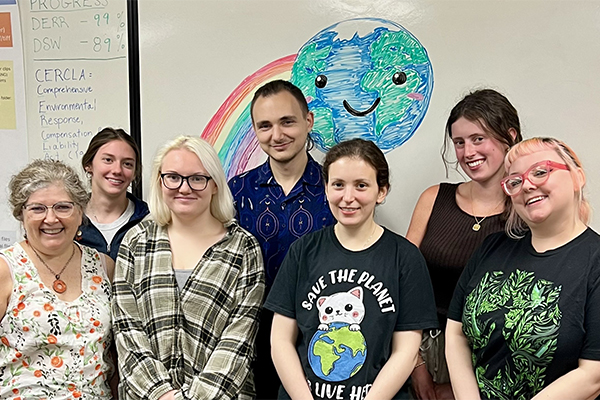 My favorite visit was to ReWorks in Stow, Ohio, a regional resource dedicated to waste reduction, community recycling programs and environmental education. Their new building, designed to be constructed from ecoblocks and insulated with reused denim, exemplifies circular economy principles I’ve become more familiar with through the Sustainability Student Leaders program. Seeing these facilities firsthand deepened my understanding of how policy, documentation and fieldwork intersect to advance environmental protection across Ohio.
Working alongside professionals dedicated to protecting our planet deepened my understanding of sustainability in practice and strengthened my commitment to pursuing a career that advances environmental stewardship and community resilience.
I am incredibly grateful for the opportunity to learn from such dedicated professionals and to contribute to meaningful environmental work. This internship not only expanded my technical skills but also reaffirmed my passion for sustainability and public service. This internship was an experience that offered both professional growth and a deeper appreciation for the impact of environmental protection, deepening my interest in this sector post-graduation.