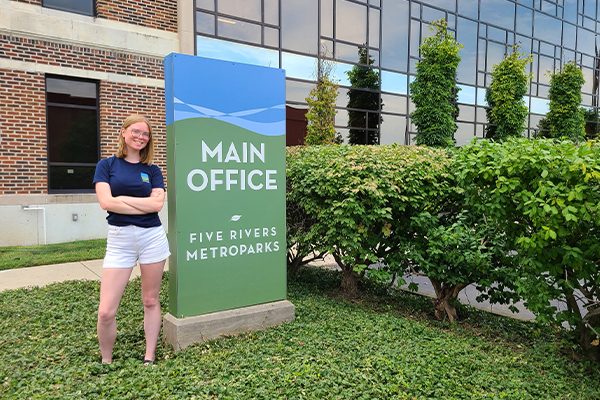
With this being the second summer I have worked with Five Rivers MetroParks through the Undergraduate Sustainability Fellowship, I have gained so much experience and knowledge. Getting to know the behind-the-scenes work of an agency I’ve loved for a long time has taught me that multiple fields of work can and should be applied for effective sustainability action to occur.
Growing up in the Dayton area, I frequented Five Rivers parks; my most visited were the Cox Arboretum, Riverscape and Wegerzyn Gardens MetroParks. Working with the agency that manages those spaces, for not only one summer but two, has been very fulfilling. I realized upon starting my work with them last summer that there was a lot I didn’t know about what they do. Despite being from the area, I still wasn’t familiar with all of the parks, and now, I am proud to say that I have been to all 18.
2025 Summer Fellowship
In 2025, I was reporting to both the conservation team and the marketing team. I had the opportunity to go out into the field and conduct surveys of conservation areas, but I also got to help produce educational materials and participate in media opportunities. I was offered many unique projects to work on and other events to get involved in, which led me to hone my eye for design, develop an interest in plant identification and learn about sustainability communication techniques.
These skills were all somewhat foreign to me before last summer. However, I quickly realized their importance and wanted to learn more about each when I returned to class in the fall. I hadn’t considered that working for a conservation-focused agency like the MetroParks would be a great application for my degree in sustainability. Clean air, clean waterways, well-managed green spaces and trails are all ambitions of sustainable communities, and can all be found throughout Montgomery County in large part because of Five Rivers MetroParks.
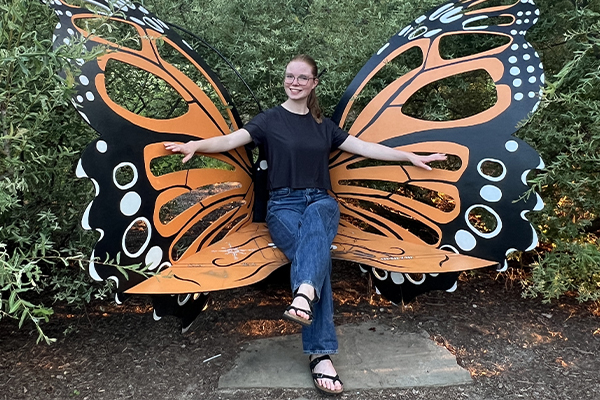 2026 Summer Fellowship
Coming back to the same position this summer, I fell back into the rhythm quickly. I felt more confident, having already developed an understanding of how the agency operates. I’ve also been able to apply information I learned last year through both my previous summer fellowship and my work during the school year with the Sustainability Student Leaders. Supporting the implementation of new standardized waste signage and infrastructure on campus gave me a stronger understanding of not only what materials can and cannot be recycled, but also how to communicate that information effectively to users. I applied this experience while conducting a waste audit for MetroParks this year and developing recommendations based on my findings.
Over the course of the summer, I was also able to work on waste reduction initiatives, including waste station operations and education about waste diversion at park events. Building on the education and outreach aspect of my fellowship, I worked on a rack card explaining MetroParks’ sustainability efforts and starting points for readers to incorporate sustainable living practices in their lives, as well as writing a blog post covering the topic of Plastic-Free July, which was included in the July MetroParks Monthly issue.
Between the two years, I’ve had many similar opportunities. One thing that consistently presented itself was tabling at events and interacting with residents who use the parks. Outreach allowed me to contextualize the interaction between strategy and action.
What I’ve Learned
One of my biggest takeaways is that even fields of work that seemingly have little to do with sustainability could be applied to necessary climate action. I used to have no interest in business or marketing because I had the mistaken belief that you’d have to work for a for-profit company whose only purpose is to make money. But sustainability-focused companies, non-profit organizations and governmental agencies like Five Rivers also need marketers to get their messages across in an approachable way.
Learning from the MetroParks marketing team taught me how important wording and proper communication are, especially when interacting with the public. Now, I’ve gained training on how to talk or write about sustainability in a way that will be well-received by many, a skill that is mastered by marketers in this field.
In many ways, sustainability is about collaboration. There’s no one person who can do all the things that need doing, but there are a lot of people who care, which is why creating connections and forming community is so important. The synergy between many different skills and talents is what allows the best work in sustainability to get done. As a factor of that equation, I’m excited to continue working on engaging sustainability projects for the rest of this summer and beyond.