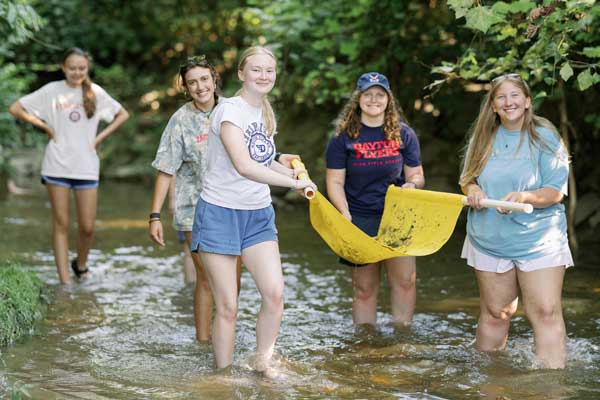
"Immersive" learning is more "submersive" learning for the University of Dayton River Stewards, whose school year kicked off with a "shocking" experience learning about monitoring the health of local waterways.
For almost 20 years, the River Stewards, students who spend three years participating in mini-courses and community service on the environment, sustainability and clean waterways, return to school early for three days of camping, kayaking and monitoring Dayton-area waterways.
At one session, students heard from Ohio Department of Natural Resources staff who had just shocked fish to capture and evaluate them to gauge the health of the Great Miami River near Dayton's Island Metro Park.
"We apply the electricity to the water and it creates basically an electrified field in the water around the boat. As we move along the shoreline, the fish get into that field. They get stunned, for lack of a better word, shocked. They kind of float to the surface, so they'll get stunned for just a second. Then we have long nets with a fiberglass handle so we don't get electrified, and we scoop the fish and put them in the live well," said ODNR fisheries biologist Kipp Brown
The fish tell ODNR staff the quality of the river by their age and size. For example, Brown said sucker fish are some of the best indicators of river health because they eat only insects.
"If this area was not good, there's no food, and none of these fish. To see the size of them, the number of them, it's a really encouraging thing," he said.
In addition to sucker fish, the students got to examine fish from the minnow, sunfish, bass and catfish families.
The students also waded in a stream feeding the Mad River sifting for macroinvertebrates, critters without a backbone that are large enough to see without a microscope. The group found mayfly larvae, aquatic isopods, and riffle beetles scooping the stream bed and turning over rocks. The students scored each macroinvertebrate species, hoping to get a score in the teens, which indicates a less-polluted waterway. Each species was worth one, two or three points, with the highest number being the least tolerant of pollution.
"I thought both were really interesting, seeing pollutants and what you can tell about each organism with the macroinvertebrates. In the stream, you can see the results of pollution that entered the stream during the last weeks or months," she said. "Whereas with fish, you're seeing a lot more of the long-term effects and water quality. It is all really interesting, because of how impactful our waterways are and seeing how healthy it's developed through the years," said Elena Zois, a sophomore with a double major in sustainability and human rights with a minor in pre-law. She aspires to be an environmental lawyer.
In addition to the Ohio Department of Natural Resources, the students heard from representatives from several organizations in the region, including B-W Greenway; the Behr, Valleycrest and Valley Pike Community Advisory Group; the city of Dayton Sustainability Office and Water Department, Five Rivers MetroParks, Miami Conservancy District, and the Miami Valley Regional Planning Committee.
"Our region's drinking water is sourced from the Great Miami Buried Aquifer, so the interconnectedness of water means it’s crucial we have clean rivers and streams feeding it," said Mackenna Cristilly, student engagement coordinator for environmental stewardship and sustainability in UD's Fitz Center for Leadership in Community and the coordinator of the River Stewards. "Alongside Zach Piso, UD associate professor of philosophy and faculty fellow with the River Stewards, and River Stewards graduate assistant Zach Raniszeski; we hope to have facilitated an orientation week that provides the newest Rivers Stewards an introduction to how to protect our waterways for future generations."